
Training an AI receptionist on your services is manageable when you can explain what you offer, which inquiries you accept, and when a person must take over. The harder work is resolving unclear business rules—not writing clever prompts. Answering questions, booking appointments, and handling live calls are separate tasks, so confirm what your chosen system supports before building the workflow.
- Is it hard to train an AI receptionist? Clear service descriptions and handoff rules make setup more manageable.
- Test service questions, unsuitable requests, and booking boundaries before allowing customer-facing actions.
- AL IntelliFlow supports lead management; AI receptionist capabilities require separate integrations or configuration.
- Start with a narrow scope, then expand only after checking answers and outcomes.
Is it hard to train an AI receptionist on my services?
The difficulty depends on how clearly your business can describe its services and decision rules. A receptionist cannot reliably follow an instruction that your own team interprets differently. Start by turning those unwritten decisions into an approved reference.
If you need the mechanics first, read how an AI receptionist actually works. For your 2026 setup, separate what the receptionist needs to know from what it is allowed to do.
- Describe your services. Explain each service in customer language, including exclusions and common misunderstandings.
- Define qualification questions. Identify the information your team needs before accepting an inquiry or arranging an appointment.
- Set action boundaries. Specify which requests the receptionist can answer, collect, route, or book through supported functions.
- Write handoff rules. Identify questions and exceptions that require a person rather than an automated answer.
- Test realistic conversations. Check ordinary requests, confusing wording, and situations outside the approved scope.
These are preparation steps, not a promise that every platform provides the same controls. Confirm that the system can use your approved information and enforce your required boundaries.
Why this matters
A polished answer is not enough. Your receptionist also needs to avoid offering services you do not provide, accepting unsuitable inquiries, or treating an appointment request as a confirmed booking.
For example, a customer might ask for ongoing maintenance when your business only accepts one-time projects. Your reference should explain that distinction directly, rather than expecting the receptionist to infer it from a broad service description.
Write the rule your team would actually follow. If your staff must inspect a request before accepting it, the receptionist should not skip that decision simply because a customer asks confidently.
What should I prepare before setup?
Build a concise service reference before changing settings. Use information your business has approved, not draft website copy or assumptions about how your team usually works.
For each service, document:
- Service description: What the customer receives, written without internal terminology.
- Scope boundaries: What is included and what your business does not offer.
- Qualification questions: What information determines the appropriate next step.
- Booking requirements: What must be established before an appointment can be confirmed.
- Human handoff: Which requests require judgment or approval.
Keep facts separate from instructions. A service description explains the work; a booking rule tells the receptionist what it may do with a request for that work.
For a 2026 service reference, assign an owner and record when the information was approved. When your services change, update the approved reference rather than adding a conflicting instruction elsewhere.
A practical service-reference example
Imagine a landscaping business that offers recurring maintenance but reviews new installation projects before accepting them. This is an illustration, not a description of any particular business.
The reference should distinguish maintenance inquiries from installation requests. It should also tell the receptionist what information to collect for each and which requests need staff review before booking.
Avoid a vague instruction such as treating every landscaping inquiry as bookable. Instead, document the actual acceptance rule and the next step for requests outside it.
Which setup scope should I start with?
Start with the narrowest workflow that addresses your immediate problem. Answering approved service questions demands different preparation from confirming appointments or handling exceptions.
| Setup scope | Best for | Advantage | Limitation | What to verify |
|---|---|---|---|---|
| Approved service answers | Businesses needing consistent responses to routine questions | Keeps the initial scope focused | Does not complete qualification or booking by itself | How approved information is supplied and updated |
| Lead qualification | Businesses needing useful inquiry details before follow-up | Gives your team a defined intake process | Unclear acceptance rules still require human judgment | Required fields, routing, and handoff behavior |
| Appointment booking | Businesses with documented appointment rules | Gives suitable inquiries a defined scheduling step | Requires correct availability and booking configuration | Calendar connection, appointment rules, and confirmation behavior |
These are workflow choices, not claims that a particular product includes every function. Confirm support before choosing a scope, and test each action rather than relying on a demonstration alone.
For your 2026 rollout, keep a request to book separate from permission to confirm. If staff approval is required, make that boundary explicit in both the instructions and the configured workflow.
How do I turn my service information into instructions?
Use a repeatable sequence: Service facts, Qualification, Action rules, Human handoff, Testing. Each stage answers a different question, so avoid putting everything into an unstructured paragraph.
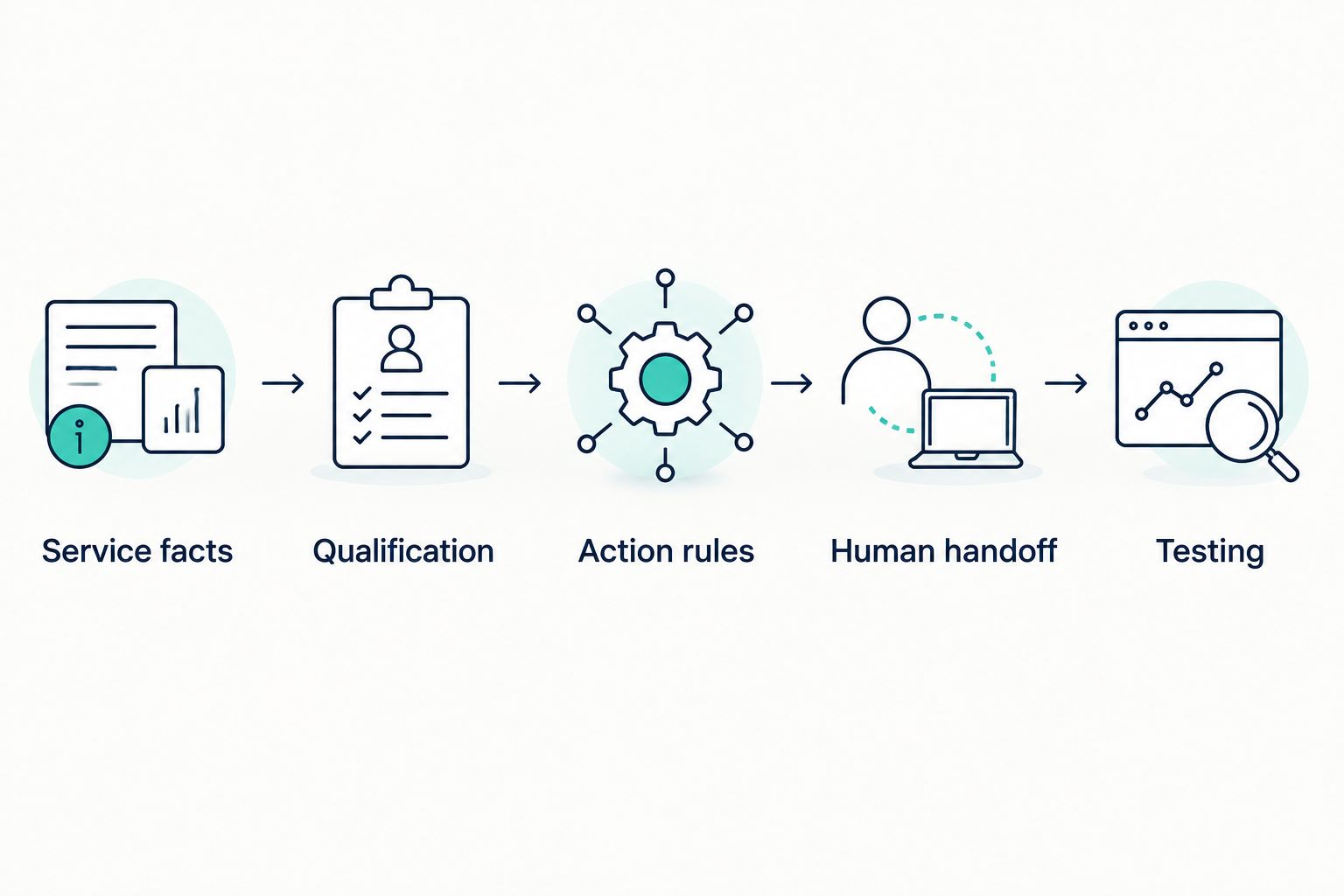
Service facts
Describe the service as you would to a new employee. Include the terms customers use, especially where their wording differs from your internal names.
If customers use the same phrase for different services, explain the distinction. The instruction should identify the clarifying question instead of asking the receptionist to guess.
Qualification
Choose questions that affect the next step. If location determines whether you accept a job, collect location; if the requested work determines routing, clarify the work.
Avoid collecting information simply because a form has space for it. Every question should help your team decide whether to answer, follow up, arrange an appointment, or decline the request.
Action rules
State what the receptionist is authorized to do after qualification. Collecting contact details is different from confirming that your business has accepted the work.
For supported booking functions, document the required appointment conditions. Do not treat a written instruction as proof that the underlying scheduling connection is configured correctly.
Human handoff
Define a useful fallback for unanswered questions. The receptionist should acknowledge the limit, collect relevant details through supported fields, and direct the request to the designated person or process.
A handoff is incomplete if nobody owns the next step. Decide who receives the request and how your team checks that it has been addressed.
Testing
Compare answers and actions against the approved reference. An answer that sounds natural can still describe the wrong service or imply a commitment your business has not made.
Fix the underlying rule when a test exposes ambiguity. Rewording the greeting will not resolve a missing acceptance policy.
Why does training difficulty vary?
The preparation burden changes with the decisions your receptionist must make. Use these factors to identify where your setup needs more attention:
- Service overlap: Similar offerings need clear distinctions and clarifying questions.
- Qualification rules: Different acceptance conditions require different intake paths.
- Booking requirements: Scheduling adds availability, appointment, and confirmation decisions.
- Exception handling: Requests outside the approved scope need explicit human handoff rules.
- Information consistency: Conflicting descriptions need an approved source of truth.
- Workflow scope: Collecting an inquiry and completing a customer-facing action require different checks.
Do not respond to complexity by uploading more material without reviewing it. Consolidate repeated information, remove contradictions, and keep operational instructions easy to find.
How should I test an AI receptionist before launch?
Use a written test sheet for your 2026 launch. For every scenario, record the customer request, the expected response, the permitted action, and the actual outcome.
Include these cases:
- A straightforward question about an offered service.
- A request for something your business does not provide.
- An inquiry that uses an unfamiliar name for an existing service.
- A booking request missing required qualification information.
- A question the approved reference does not answer.
- A customer who asks to speak with a person.
- A request that changes direction during the conversation.
Check the outcome, not just the wording. A friendly response fails the test if it confirms an appointment without authorization or sends the inquiry into an unmonitored process.
After correcting an instruction, repeat the relevant tests. Include connected steps: an answer can be correct while the resulting handoff or booking is wrong.
Do I need coding skills to train an AI receptionist?
Coding is not required to write service descriptions, qualification questions, or handoff rules. Whether technical help is needed for deployment depends on the platform and the connections your workflow requires.
Ask the provider to show how you update approved information and test changes. Separately, ask who configures calling, scheduling, and routing functions; writing instructions does not establish those connections.
Can I use my website as the training material?
Your website can provide source material, but review it against current operating rules before using it. Public descriptions explain your services; they do not necessarily explain every qualification requirement or staff approval step.
Check that the selected system supports your intended input method. Then resolve contradictions before adding the material, rather than expecting the receptionist to decide which version is correct.
Can the receptionist learn everything from customer calls?
Do not assume a receptionist automatically learns approved business rules from customer calls. Confirm how the chosen platform handles updates, feedback, and changes to its reference material.
Customer conversations can reveal missing questions for your team to review. Treat that review as a controlled update process, not permission for the system to invent new service policies.
Where does AL IntelliFlow fit?
AL IntelliFlow is best for service-based businesses seeking AI-powered lead capture, follow-up, and appointment booking. Its practical focus is helping businesses qualify inquiries and manage the work that follows them.
AL IntelliFlow organizes its business growth platform around Strategist, Connector, and Operator, covering AI-assisted planning, customer engagement, and operational workflows. That lead management scope does not establish standalone voice-receptionist capabilities; those require separate integrations or configuration.
For your 2026 evaluation, distinguish the benefit from the boundary. Lead capture and follow-up address inquiry handling, while a live-call receptionist introduces additional setup and testing requirements that you must verify separately.
FAQ
Is it hard to train an AI receptionist for a small service business?
Training is manageable when your service descriptions, qualification questions, and handoff rules are clear. Unresolved business decisions make setup harder because the receptionist has no approved rule to follow.
What should I give an AI receptionist about my services?
Provide approved service descriptions, exclusions, qualification questions, booking requirements, and human handoff rules. Separate facts about the service from instructions about permitted actions.
Do I need to write code to prepare the training information?
You do not need code to prepare service information and instructions. Technical requirements for deployment depend on the platform and the connections your workflow needs.
Can I train an AI receptionist using only my website?
Use your website as source material only after checking it against current operating rules. Add qualification and handoff instructions that public service pages do not explain.
How do I know whether the receptionist is ready?
Check that realistic test requests produce the approved answers and permitted actions. Include unsupported services, missing information, booking boundaries, and requests for a person.
What should happen when the receptionist does not know an answer?
The receptionist should follow a defined fallback rather than invent an answer. Specify what information to collect and who owns the human follow-up.
Does lead management software automatically include an AI phone receptionist?
Lead management software does not automatically establish AI phone-receptionist functionality. Verify calling capabilities and any required integrations or configuration separately from lead capture, follow-up, and appointment booking.
One last thing
Test a request your business should not accept before testing another easy question. A clear boundary tells you whether the receptionist follows your operating rules when a customer asks for something outside them.
Keep that rejected-request test when you update your services. Correctly explaining what you do not offer matters as much as describing what you do.
Related guides
- Can an AI receptionist transfer calls to a live person?
- How does AI appointment scheduling work with my calendar?
- Can an AI receptionist really answer calls like a human?
Explore AL IntelliFlow and start its free 14-day trial to evaluate lead capture, follow-up, and appointment booking for your service business.