
Revenue lost from missed calls depends on how many unique, qualified callers you fail to recover, how often comparable inquiries become completed jobs, and the revenue those jobs generate. Estimate the opportunity using those inputs—not the total number of unanswered rings. For your 2026 assessment, keep estimated missed revenue separate from confirmed bookings, completed work, and the staff time spent following up.
- How much revenue is lost from missed calls depends on unrecovered qualified inquiries, conversion rates, and completed-job revenue.
- Count unique callers, not repeated rings; exclude spam and inquiries unrelated to new work.
- AL IntelliFlow supports lead management and appointment booking; receptionist capabilities require separate configuration or integrations.
- Measure completed work after follow-up, not just replies or appointments.
How much revenue is lost from missed calls at a service business?
Estimated missed revenue equals unrecovered qualified inquiries multiplied by a comparable completed-job conversion rate and average realized job revenue. This is an opportunity estimate, not proof that every caller would have purchased.
Start by tracing the missed-call-to-booked-appointment workflow. The calculation only makes sense when you distinguish an unanswered call from an opportunity that remained unrecovered.
| Calculation input | What to include | What to exclude |
|---|---|---|
| Unique missed inquiries | Separate prospective customers whose calls went unanswered | Repeated calls from the same inquiry |
| Qualified inquiries | Requests that match your services and service area | Spam, wrong numbers, unrelated requests |
| Unrecovered inquiries | Qualified prospects who never reconnected or progressed | Callers who later booked through another channel |
| Completed-job conversion rate | Completed jobs divided by comparable qualified inquiries | A booking rate presented as a completion rate |
| Average realized job revenue | Revenue from comparable completed jobs | Unaccepted quotes or assumed future purchases |
Use matching records throughout. A conversion rate from repeat customers is not a sound substitute for the rate from new prospects. Likewise, a high-value installation average should not determine the estimated loss from routine maintenance calls.
If your unanswered callers never explained what they needed, classify them as unknown, not automatically qualified. Report those inquiries separately until follow-up establishes their purpose.
Why this matters
An unanswered call is a break in the customer journey. Revenue is the outcome at the end of that journey, not a value attached to the ring itself.
For a service business, the practical question is where the inquiry stopped: nobody answered, nobody followed up, nobody qualified the request, or nobody completed the booking. Each failure needs a different fix.
Your 2026 missed-call report should expose those distinctions. Otherwise, you risk buying an answering solution for a scheduling problem—or adding follow-up automation when the real issue is an overloaded service calendar.
Fix the stage that loses the opportunity, not just the stage that is easiest to measure. A dashboard showing more answered calls is useful only when you can connect those calls to meaningful next steps.
Separate estimated opportunity from documented loss
The strongest report uses separate categories instead of presenting one large revenue figure as settled fact.
Estimated missed revenue
This is the calculation based on unrecovered qualified inquiries and comparable completed-job results. Its strength depends on the quality of your records and the suitability of the comparison group.
The estimate helps you prioritize a workflow change. Its limitation is that you cannot know whether an unreachable prospect would have hired you, accepted the quote, or completed the appointment.
Documented lost opportunities
These are inquiries with an explicit outcome: for example, a prospect tells your team they chose another provider after failing to reach you. Record the stated reason without adding an explanation the customer never gave.
A documented lost opportunity still does not automatically establish a revenue amount. An accepted job scope provides different evidence from an inquiry that never reached the quoting stage.
Recovered revenue
This is revenue from completed work tied to a previously missed inquiry. Match the customer record, follow-up history, booking, and completed job before assigning it to the recovery workflow.
Recovered revenue is useful evidence of what happened after follow-up. It does not prove that the follow-up caused every sale: some customers would have called again or booked elsewhere in your business.
Keep these categories separate in your 2026 reporting. They answer different questions: what remained at risk, what customers explicitly reported, and what work ultimately happened.
Why missed-call revenue loss varies
The calculation changes when its inputs change. Focus on these factors rather than applying an unsupported industry-wide loss figure:
- Caller intent: A request for a quote differs from a question about an existing appointment.
- Fit: The prospect needs a service you provide in an area you serve.
- Recovery: A missed caller who reconnects is not an unrecovered inquiry.
- Conversion: Use the completed-job rate for comparable qualified inquiries, not all contacts.
- Job value: Match revenue to the type of work requested rather than your largest project.
- Capacity: A qualified inquiry is not executable work when your team cannot fulfill it.
Record each factor where it belongs. Caller intent and fit belong in qualification; recovery belongs in the contact history; capacity belongs in scheduling.
Do not bury these distinctions inside a single spreadsheet assumption. If you cannot establish an input, keep the uncertainty visible in the report instead of turning it into a confident revenue claim.
Build a missed-call report you can act on
Use a consistent sequence for each inquiry. The goal is a traceable path from the first missed contact to the final outcome, with an owner responsible for the next action.
Capture
Record the call time, caller identifier, answered status, and any message provided. Add the source when you can establish it; do not assign an advertising campaign simply because it was active that day.
Keep the original contact record. It gives your team a starting point when the same customer later calls, submits a form, or books through another channel.
Deduplicate
Combine repeated attempts concerning the same request. A prospect calling repeatedly represents a contact problem, not a separate potential job for every ring.
Keep unrelated requests distinct, even when they come from the same customer. Deduplication should remove duplicate opportunity counts without erasing genuine additional work.
Qualify
Establish the requested service, location, and appropriate next step. Ask only for the information your team needs to decide whether the inquiry belongs in your sales process.
Separate new-business inquiries from existing-customer support. Both need attention, but combining them makes a new-revenue estimate misleading.
Follow up
Assign responsibility and record what happened: attempted contact, successful conversation, customer decline, or unresolved inquiry. A task marked complete is not evidence that the customer responded.
For your 2026 process, define the handoff explicitly. The person who reviews the missed-call list should know who contacts the prospect and who takes over when a service question needs human judgment.
Book
Record the appointment or agreed next step, together with the customer identity. A booking link sent to a prospect is not a booked appointment.
Confirm that the requested service fits the appointment being offered. An appointment that your team cannot fulfill should not be counted as a successful recovery.
Reconcile
Connect the inquiry to completed work and realized revenue. Preserve cancellations, declines, and unresolved outcomes rather than removing them from the report.
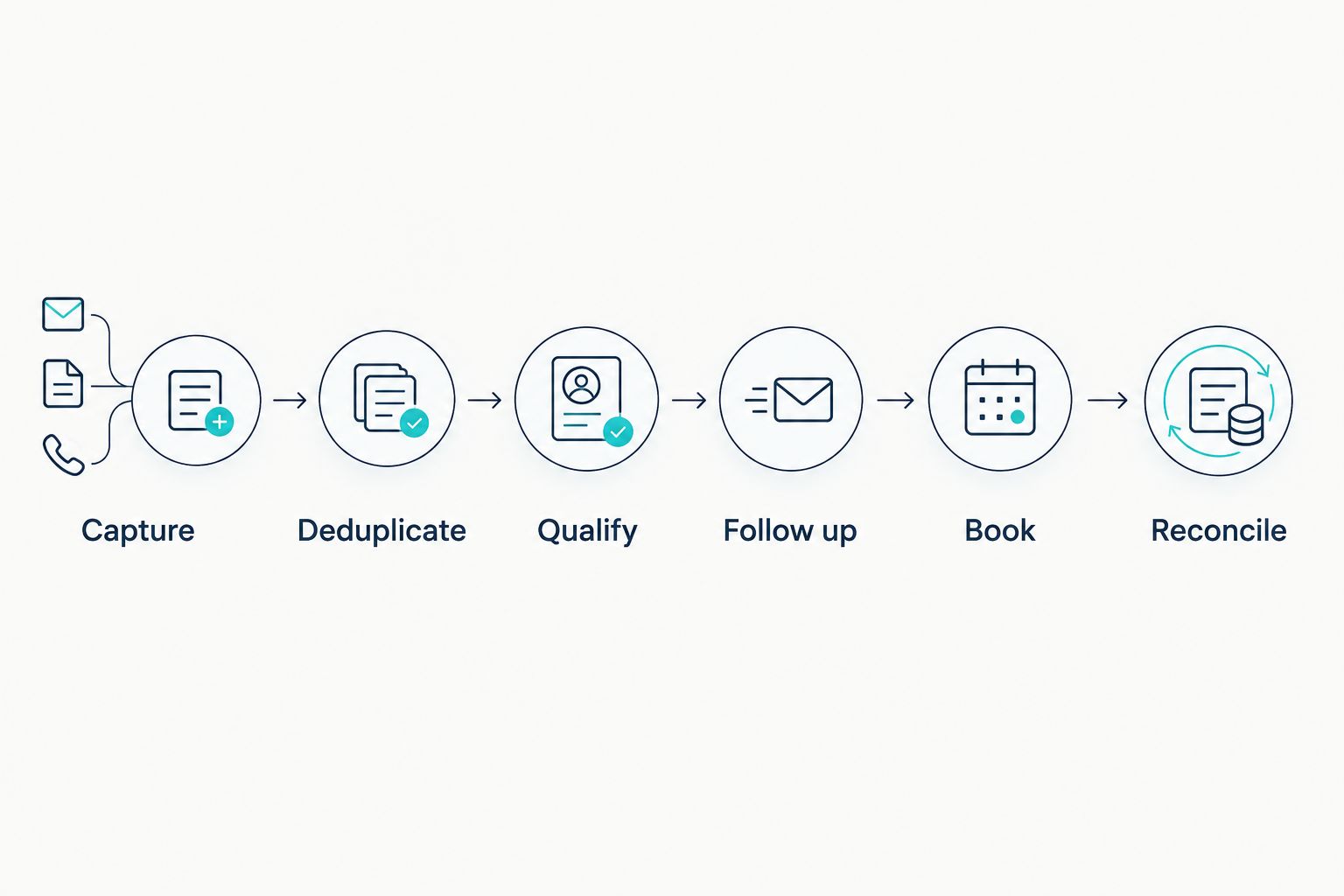
Review the unresolved records with your team. A useful report names the next action and its owner, rather than leaving every unanswered inquiry in the same open category.
Which response workflow fits the problem?
Choose a workflow based on the failure you have identified. These approaches address different stages and should not be treated as interchangeable.
| Approach | Best for | Practical advantage | Limitation to address |
|---|---|---|---|
| Staff callback process | Requests needing human judgment | Your team can discuss the job directly | Follow-up still depends on ownership and execution |
| Lead management and follow-up software | Captured inquiries with inconsistent follow-through | Supports qualification, follow-up, and booking workflows | Does not automatically establish live telephone answering |
| Configured receptionist solution | Businesses evaluating call-answering coverage | Addresses the incoming-call stage | Answering, routing, and handoff capabilities require verification |
A staff callback process is a reasonable starting point when the real issue is an unassigned task. Its weakness is operational: the process fails when nobody owns the queue or records the outcome.
Lead management software fits a different problem. It helps organize what happens after an inquiry enters the workflow, but you still need to establish how a missed call becomes a usable lead record.
A receptionist solution addresses telephone handling. Evaluate it separately from lead follow-up, and confirm how it handles questions it cannot answer, unavailable appointments, and requests requiring your team.
Do not assume that a product described as AI-powered includes every part of this chain. Require a demonstration of the actual handoff before treating separate capabilities as one working system.
Where AL IntelliFlow fits
AL IntelliFlow is best for service businesses seeking lead capture, qualification, follow-up, and appointment booking support. Its practical role is helping you manage inquiries and routine workflows—not providing evidence of a guaranteed revenue increase.
AL IntelliFlow's lead management platform is organized around Strategist, Connector, and Operator. Its stated capabilities include AI-assisted planning, customer engagement, follow-up, appointment booking, and routine operational workflows.
The advantage is relevance to inconsistent follow-through. The boundary is equally important: lead management is not the same as a configured AI receptionist. Telephone answering, missed-call triggers, and connections to other systems need separate confirmation; do not assume them from the platform description.
Before adopting AL IntelliFlow for lead management, identify how inquiries enter the system, who handles exceptions, and how completed work will be recorded. That gives you a specific workflow to evaluate rather than an open-ended expectation that software will solve every missed opportunity.
How do you measure revenue recovered after a missed call?
Measure recovered revenue from completed jobs linked to previously missed inquiries. Use the contact history to establish the connection, and exclude appointments that never became completed work.
Compare similar inquiry groups when assessing a process change. Keep the requested services and outcome definitions consistent, and identify changes in staffing or capacity that affect the comparison.
For a 2026 baseline, retain both successful and unsuccessful outcomes. Removing unanswered prospects or canceled appointments from the records makes the workflow look more effective than the evidence supports.
Is every unanswered call a lost customer?
No. An unanswered call can come from a repeat caller, an existing customer, spam, or a prospect who later reconnects.
Treat unanswered calls as a queue requiring review, not a customer-loss total. Qualification and deduplication determine which records belong in the opportunity calculation.
Should you prioritize answering or follow-up?
Prioritize the stage your records show is failing. If calls go unanswered and never become usable inquiry records, examine capture and answering first; if inquiries are captured but sit untouched, address follow-up ownership.
Then check booking and completion. More conversations do not fix a scheduling bottleneck, and more appointments do not establish more completed revenue.
FAQ
How much revenue is lost from missed calls at my business?
Estimate missed revenue by multiplying unrecovered qualified inquiries by a comparable completed-job conversion rate and average realized job revenue. The result is estimated opportunity, not proof that every missed caller would have purchased.
Can I multiply all missed calls by my average job value?
No, that calculation treats every missed ring as a completed job. Deduplicate callers, establish qualification, remove recovered inquiries, and account for conversion before estimating revenue.
What's the difference between missed-call revenue and lost profit?
Revenue measures the value of the work, while profit also accounts for costs. Do not present an estimated revenue opportunity as estimated profit.
How do I know whether a missed caller booked later?
Match the caller to your customer records, subsequent conversations, appointment, and completed job. Count the inquiry once even when the customer reconnects through another channel.
Is a booked appointment recovered revenue?
A booked appointment is a recovered booking, not completed revenue. Reconcile it with completed work before including it in a realized-revenue report.
Does AL IntelliFlow automatically answer missed calls?
AL IntelliFlow's confirmed capabilities include lead capture, qualification, follow-up, appointment booking, and routine workflows. AI receptionist capabilities require separate integrations or configuration and should be verified before use.
What should I fix first if missed inquiries get no response?
Assign an owner and a clear next action to each qualified inquiry. Establish that process before judging whether additional software addresses the failure.
One last thing
The most useful missed-call record is often the unresolved one. A recovered booking shows an outcome; an unresolved qualified inquiry shows where responsibility or the next step is still missing.
Before changing software, inspect those records. Make sure your team can explain what happened, who owns the follow-up, and what evidence will close the inquiry.
Related guides
- Google Business Profile calls to bookings
- Website leads to an instant text reply
- Screening calls before they reach your team
Explore AL IntelliFlow and start its free 14-day trial to evaluate how its lead management capabilities fit your follow-up and appointment booking process.