
Yes—an AI receptionist can qualify leads before they reach a human by asking approved questions, checking answers against your service criteria, and passing the relevant details to your team. In 2026, the deciding factor is the configured workflow: voice handling, qualification rules, and handoff connections must work together, and unclear requests still need human judgment.
- Can an AI receptionist qualify leads before a human? Yes, with approved questions, clear qualification rules, and tested handoffs.
- AL IntelliFlow supports service-business lead qualification and follow-up; receptionist capabilities require separate integrations or configuration.
- Use service fit, location, and timing to guide the next action—not assumptions about a caller's value.
- Keep human review available when answers are incomplete, contradictory, or outside your approved rules.
Can an AI receptionist qualify leads before they reach a human?
Yes, for defined screening tasks—not unrestricted sales judgment. A configured AI receptionist can collect the information your team needs to decide whether to book, follow up, or speak directly with the caller.
The distinction matters: collecting a name and phone number captures a lead; checking whether the requested service matches your business qualifies it. Neither action proves that the caller will become a customer.
Start by separating call screening before a request reaches your team from the final sales decision. Your receptionist should prepare a useful handoff, not make promises your team cannot honor.
| Approach | Best for | What it contributes | Main limitation |
|---|---|---|---|
| AI-only screening | Routine inquiries with explicit rules | Consistent intake and an initial routing decision | Unusual requests need an exception path |
| Human-only intake | Complex or sensitive conversations | Follow-up questions and contextual judgment | Staff must handle the initial conversation |
| AI screening with human review | Repeatable intake with occasional exceptions | Structured information before a person takes over | Requires clear ownership and tested handoffs |
Use AI screening with human review when your intake questions repeat but your sales decisions require context. Keep the automated decision narrow enough that you can explain why each caller received a particular next step.
Why this matters
A missed opportunity is not always an unanswered call. It can also be a captured inquiry that reaches the wrong person, lacks essential details, or sits without an agreed next action.
For your 2026 workflow, the useful outcome is a clearer conversation—not simply fewer conversations. A team member should know what the prospect wants, what remains uncertain, and what happens next without repeating the entire intake.
For example, a landscaping business might need to know whether a caller wants recurring maintenance or a new installation. That distinction helps route the inquiry; it does not authorize the receptionist to promise that a particular job is suitable or accepted.
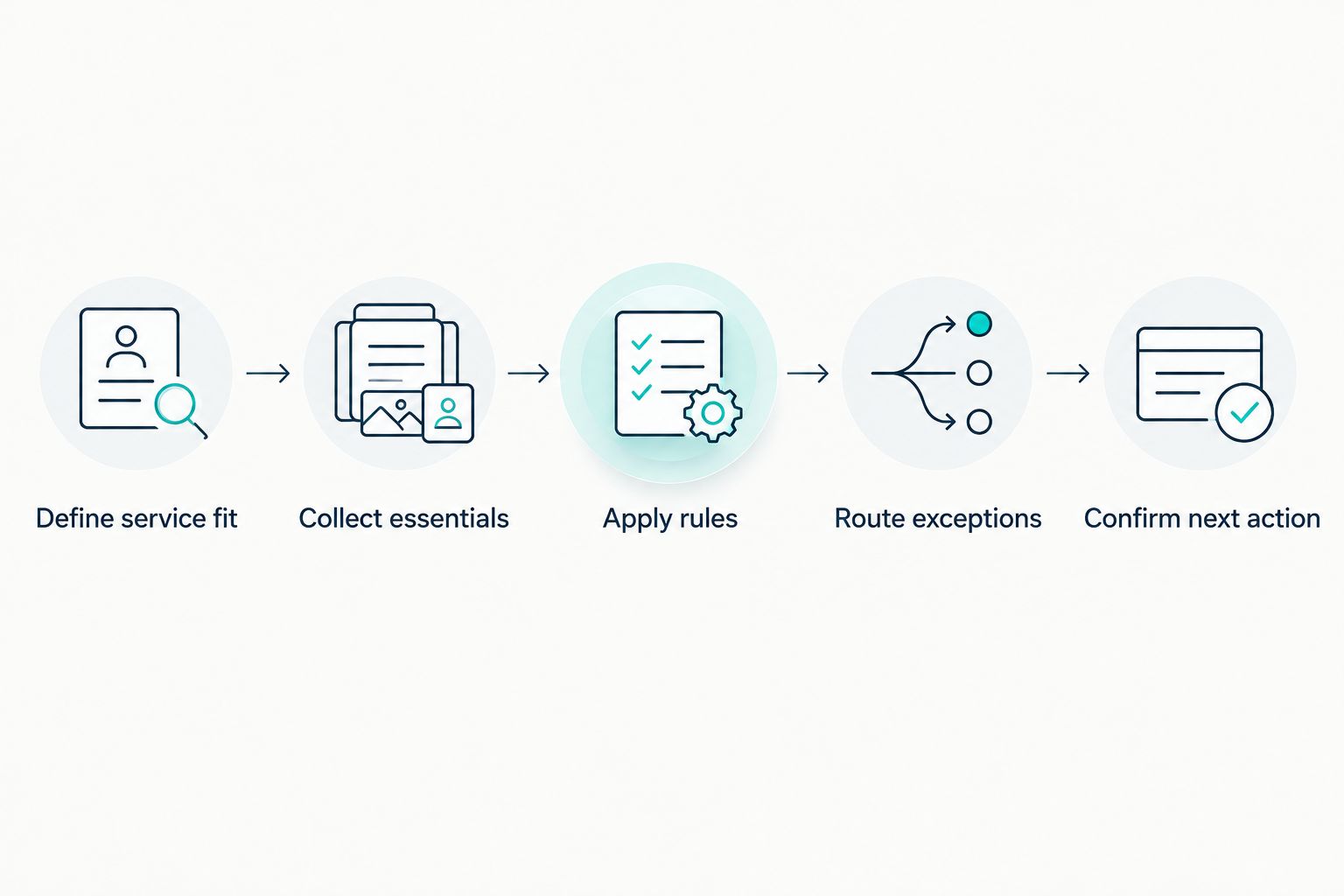
Build lead qualification in 5 steps
Treat this as a setup sequence, not a claim that every receptionist product includes every capability. Verify each step in the system you plan to use.
1. Define service fit
Write down the services you accept and the boundaries that affect routing. Use terms customers actually say, rather than relying only on internal service names.
Ask a direct question such as what work the caller needs. If the answer does not match an approved category, preserve the caller's wording and send it for review instead of forcing a match.
2. Collect essentials
Choose the details a person needs before continuing the conversation. For a location-based service, those might include the requested work, service location, timing, and a callback method.
Ask only for information that changes the next action. A question that neither affects qualification nor helps the handoff adds friction without improving the decision.
3. Apply rules
Translate your intake policy into explicit conditions. A service-area rule should compare the provided location with your approved coverage, not infer suitability from how the caller sounds.
Keep unknown answers separate from negative answers. Someone who cannot describe the work precisely is not automatically a poor-fit lead.
4. Route exceptions
Create a human-review path for contradictions, unusual requests, and callers who ask to speak with a person. Give that path an owner.
Do not treat a failed transfer as a completed handoff. Define what the system should do when nobody answers, including how it records the request and assigns follow-up.
5. Confirm next action
End with a specific, accurate explanation of what happens next. Distinguish a request for an appointment from a confirmed booking, and a requested callback from a completed transfer.
Your 2026 launch checklist should test these distinctions before callers encounter them. A qualification workflow is incomplete until the next person can act on its output.
Use 3 outcomes instead of a vague lead score
A score is not a handoff instruction. Start with outcomes your team understands, then add scoring only if it changes a real decision.
Ready for booking
Use this outcome when the caller meets your documented intake criteria and wants the next approved step. Booking itself depends on verified scheduling capabilities and the rules you configure.
The benefit is a clear path for straightforward inquiries. The risk is confusing an intake match with an accepted job, so keep those statuses distinct.
Needs human review
Use this outcome when the request is unclear, unusual, or outside the automated decision rules. Include the unanswered question and the reason for escalation.
Human review protects against premature rejection. It also creates work for your team, so assign responsibility rather than leaving the inquiry in an unowned queue.
Outside current scope
Use this outcome only when the caller's stated request clearly conflicts with an approved business rule. Examples include a service you do not provide or a location outside your documented coverage.
This keeps routine routing consistent, but rigid rules can mishandle exceptions. Preserve the original request and provide a review path when the caller disputes the classification.
Why lead qualification quality varies
The same opening question can produce very different results depending on what happens after the answer. These factors belong in your evaluation:
- Rule clarity: Written service boundaries support consistent decisions. Informal instructions such as accepting good leads leave the central decision undefined.
- Answer handling: The workflow needs a response for incomplete, corrected, and contradictory information—not just ideal answers.
- Connection quality: Intake details must reach the destination your staff actually uses. Verify the connection rather than assuming it exists.
- Handoff ownership: Every review request needs a responsible person and an agreed next action.
- Booking boundaries: The receptionist must distinguish what it can request, what it can confirm, and what requires approval.
- Testing discipline: Realistic test conversations expose routing gaps that a polished demonstration does not address.
These are practical selection criteria for 2026. Ask for a demonstration using your service rules and exception cases, rather than judging the system solely by how natural its voice sounds.
What should an AI receptionist ask a new lead?
Ask about the requested service, relevant location, desired timing, and how to continue the conversation. Adapt the questions to the decision your business needs to make.
For a cleaning business, an illustrative intake might ask whether the request concerns a home or commercial property, what cleaning is needed, and where the property is located. Those answers guide routing without requiring the caller to understand your internal categories.
Follow-up questions should resolve uncertainty, not restart the interview. If the caller already explained the service, confirm your understanding instead of asking them to repeat it.
What information should reach the human team?
Pass along the caller's request, the facts collected, the qualification outcome, and the unresolved question. Include whether the caller requested a callback, booking, or direct conversation.
A useful handoff separates what the caller actually said from the system's interpretation. For example, a caller asking about recurring service has expressed an interest; that is not confirmation that they accepted a service agreement.
The handoff should explain the decision, not merely label the lead. Your team needs enough context to challenge a classification and continue the conversation naturally.
Where does AL IntelliFlow fit?
AL IntelliFlow lead management is best for service-based businesses that need lead capture, qualification, follow-up, and appointment booking. Its confirmed purpose is to help organize these activities and routine business workflows.
The platform is presented around three roles: Strategist, Connector, and Operator. Use that structure to consider your plan, customer engagement, and operational work without assuming that every desired workflow is already configured.
Keep the product boundary clear: AL IntelliFlow lead management is not proof of a ready-to-use voice receptionist. Call answering, live transfer, and other receptionist behavior require separate integrations or configuration and verification for your setup.
The practical fit is managing what happens to an inquiry. The limitation is that you must verify how the voice receptionist connects to that process before relying on an end-to-end call workflow.
How should you test qualification before launch?
Build a 2026 acceptance test around decisions, not a single successful call. Include an eligible inquiry, an unclear request, an out-of-scope service, a corrected answer, and a request for a human.
For every scenario, check the captured details against what the caller actually said. Then inspect the assigned outcome, the explanation given to the caller, and the information delivered to your team.
Test the failure path too. If a connection fails or a person is unavailable, the inquiry should still have a visible status and an assigned next action—not disappear between systems.
Review classification errors separately from conversation quality. A pleasant conversation that sends a suitable prospect to the wrong destination is still a failed qualification test.
FAQ
Can an AI receptionist qualify leads before a human gets involved?
Yes, an AI receptionist can qualify leads before a human by collecting answers and applying configured intake rules. Keep ambiguous requests and exceptions available for human review.
What's the difference between capturing a lead and qualifying one?
Lead capture records an inquiry and contact details; lead qualification checks the request against your business criteria. A captured contact is not automatically ready for booking.
Can an AI receptionist reject a good lead by mistake?
Yes, incorrect rules or misunderstood answers can produce a wrong classification. Treat missing information as unknown and provide a review path for disputed outcomes.
Should an AI receptionist ask every caller the same questions?
Use the same core criteria for comparable inquiries, but avoid asking callers to repeat information they already provided. Additional questions should resolve a specific gap in the intake.
Can qualified leads go straight to appointment booking?
Qualified leads can proceed to booking when scheduling capabilities, connections, and business rules support it. Verify that the system distinguishes a requested appointment from a confirmed one.
Does AL IntelliFlow include a voice receptionist automatically?
Do not assume that AL IntelliFlow lead management automatically includes a configured voice receptionist. Receptionist capabilities require separate integrations or configuration, while the confirmed platform scope includes lead capture, qualification, follow-up, and appointment booking.
What should I check before launching AI qualification in 2026?
Before launching AI qualification in 2026, test service-fit rules, incomplete answers, handoff ownership, and failed connections. Confirm that your team receives accurate details and knows the next action.
One last thing
Do not optimize qualification around keeping people away from your team. Optimize it around making the next conversation useful. A caller with an unusual request can still be a valuable prospect; the right automated outcome is often human review, not rejection.
Before adding another screening question, ask whether its answer changes routing, booking, or follow-up. If it changes nothing, remove it. A shorter, purposeful intake is easier to inspect and maintain than a long script full of unused answers.
Related guides
- How an AI receptionist actually works
- Customizing what an AI receptionist says to callers
- Transferring calls to a live person
Explore AL IntelliFlow and start its free 14-day trial to assess lead capture, qualification, follow-up, and appointment booking for your business.