
Yes, an AI receptionist can handle multiple phone lines at once when its voice service and telephone setup support concurrent calls. Each caller needs a separate active session, so the real limit is simultaneous-call capacity—not the number of phone numbers connected. Before choosing a system in 2026, verify that capacity, what happens when it is reached, and whether transfers and appointment booking work during overlapping calls.
- Can an AI receptionist handle multiple phone lines? Yes, when the telephone setup supports separate concurrent call sessions.
- Multiple phone numbers do not prove simultaneous-call capacity; verify both with the provider.
- Test overflow, live transfers, and appointment booking during overlapping calls before launch.
- AL IntelliFlow fits service businesses seeking lead management and follow-up; voice answering requires separately verified configuration.
Can an AI receptionist handle multiple phone lines at once?
Yes—but multiple numbers and multiple simultaneous conversations are different capabilities. A receptionist can serve several business numbers while still having a shared limit on active calls. Conversely, a single business number can receive overlapping calls when the telephone service supports them.
The caller-facing workflow also matters. Answering a call, collecting details, checking a calendar, and transferring to your team involve different parts of the setup. For the basic sequence, see how an AI receptionist actually works.
Use this comparison to separate the options before reviewing a provider's claims.
| Approach | Best for | Main advantage | Main limitation |
|---|---|---|---|
| AI receptionist with concurrent-call support | Routine inquiries arriving at the same time | Separate sessions can handle overlapping conversations | Capacity and supported actions depend on the configured services |
| Staff answering through a business phone system | Calls requiring judgment or personal attention | Staff can interpret unusual requests and make decisions | Each staff member can actively speak with only one caller at a time |
| Voicemail overflow | Collecting messages when nobody can answer | Gives callers a way to leave their request | Does not provide a live conversation or resolve the request during the call |
These approaches are not mutually exclusive. Your business can use automated answering for routine intake, staff for exceptions, and voicemail as a fallback. The important decision is where each call goes when the preferred route is unavailable.
Why this matters for your business
A business phone number is an entry point, not a guarantee that every caller gets help. If inquiries arrive while someone is already talking, the system needs a defined next action. Otherwise, extra numbers simply create more places for calls to stall.
For a service business, answering is only the beginning. You also need the correct contact details, a clear request, an assigned next step, and a record your team can use. A conversation that ends without ownership still leaves work unfinished.
Evaluate a 2026 receptionist setup by completed next steps, not just answered calls. Ask whether callers receive useful help, whether exceptions reach the right person, and whether your team can see what happened afterward.
What determines simultaneous-call capacity?
Concurrent-call capacity is the number of conversations the full setup can support at the same time. It is not the number of calls handled across a day, and it is not the number of telephone numbers assigned to your account.
Ask the provider to explain the following factors in plain English:
- Telephone capacity: How many active inbound calls does the connected telephone service allow?
- Voice-session capacity: How many separate conversations can the receptionist service run simultaneously?
- Shared account limits: Do different business numbers or locations draw from the same capacity allowance?
- Transfer behavior: Does transferring a caller occupy additional capacity, and when is the original session released?
- Connected workflows: Can the configured calendar or lead-management connection complete actions during overlapping calls?
- Overflow rules: What happens when another caller arrives after the setup reaches its limit?
Do not accept daily call volume as an answer to a concurrency question. A service can process calls sequentially throughout the day without supporting the overlap your business needs.
Also distinguish a limit from a fallback. A queue, voicemail route, or staff transfer describes what happens after capacity is exhausted; it does not increase the number of callers receiving an active AI conversation.
How do you verify multiple-line support before launch?
Treat the demonstration as a workflow test, not a scripted product tour. Ask the provider to use the same routing, business instructions, and connected tools you intend to use. A demonstration with different settings does not establish how your setup will behave.
Establish the limit
Request the simultaneous-call allowance in writing. Clarify whether it applies to each number, each location, or the entire account, and whether inbound calls, outbound calls, and transfers share it.
Ask what the provider means by an active call. A caller speaking with the receptionist, waiting in a queue, or transferring to staff can occupy different resources. The answer should describe your actual configuration rather than an undefined claim of scalability.
Overlap the calls
Have separate testers call while an existing conversation is still underway. Give each tester a different request and different contact details. The goal is to confirm independent conversations, not merely that the telephone rings.
Listen for correct greetings, uninterrupted responses, and separation of caller information. Ask each tester to change a detail during the conversation so you can check that the final record reflects the correction.
Check the records
Inspect the result of each call. Confirm that names, contact information, requested services, and next actions belong to the correct caller. Do not stop at the audio demonstration.
If a workflow promises a booking or follow-up action, check the destination where that action should appear. A spoken confirmation is not a substitute for a completed record.
Test overflow
Ask the provider to demonstrate the configured capacity boundary in a controlled test. Observe the next caller's experience when active sessions occupy the available capacity.
Check whether the caller hears a useful message, enters a queue, reaches staff, or leaves voicemail. Then verify who receives the unfinished request and how your team knows it needs attention.
Test handoff
Ask a tester to request a person while other calls remain active. Confirm the destination, the information passed to staff, and the fallback when that person does not answer.
A transfer is complete only when the caller reaches the intended destination or receives a clear alternative. A transfer attempt alone does not establish a working handoff.
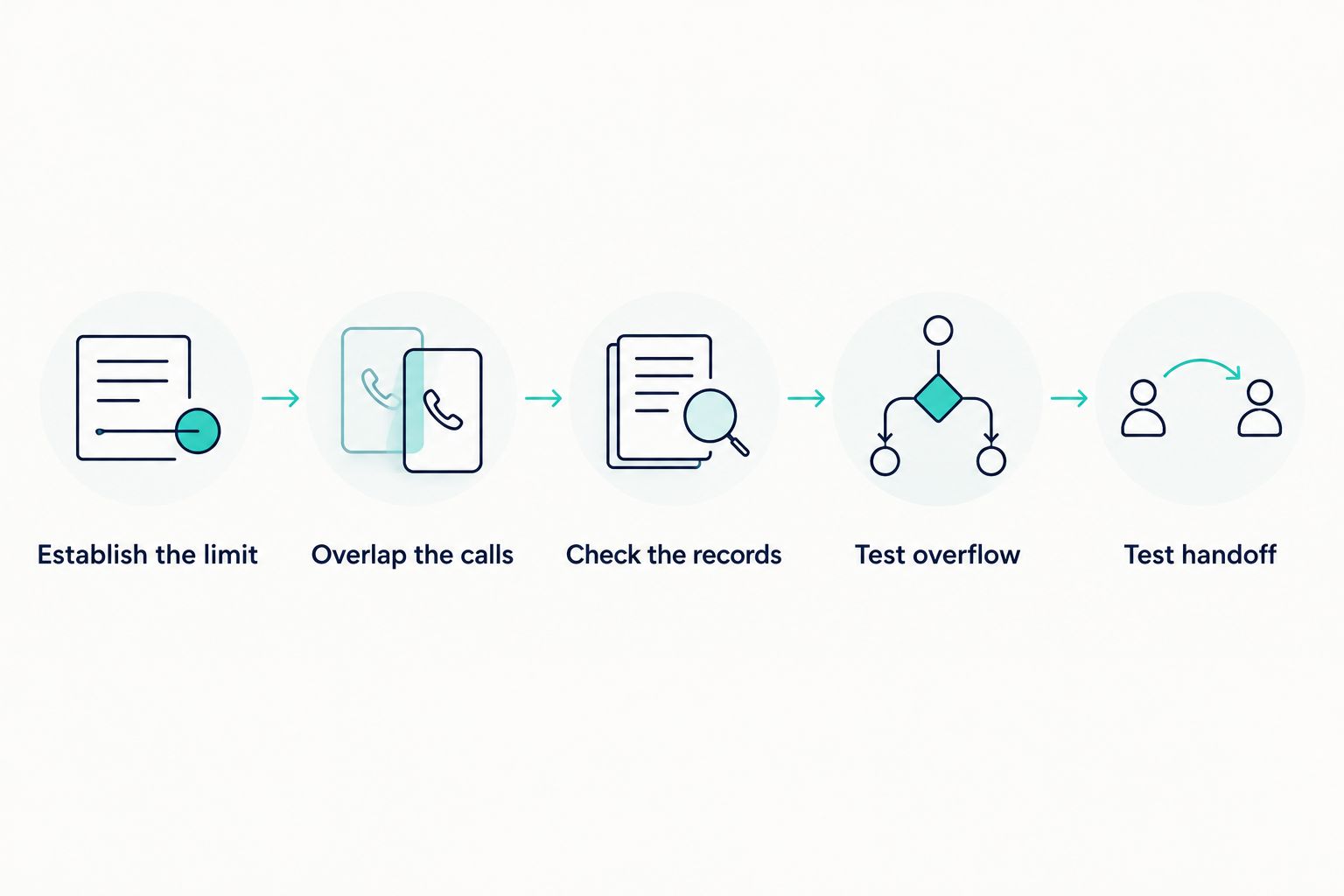
Keep a written record of the test outcomes and unresolved issues. For your 2026 launch, use those results to decide which requests the receptionist handles and which ones go directly to your team.
Can several callers book appointments at the same time?
Several callers can request appointments simultaneously, but successful booking depends on the connected scheduling system and its configuration. Concurrent conversation support does not, by itself, prove that appointment conflicts are prevented.
Test callers requesting the same appointment slot. Verify that the booking workflow checks availability when committing the appointment and does not confirm conflicting bookings. Also test a caller changing the requested time before the conversation ends.
Your scheduling rules should define the service, eligible staff member, location, and appointment requirements. These rules are business decisions; the receptionist needs an accurate configuration to apply them.
Do not treat collecting a preferred appointment time as a confirmed booking. If the system only records a request for staff approval, its spoken response should say that clearly. Your follow-up should preserve the same distinction.
Can an AI receptionist transfer callers while answering other calls?
An AI receptionist can support transfers alongside other conversations when the telephone service, receptionist service, and routing configuration support that behavior. Verify the exact transfer process rather than assuming it follows from multiple-line support.
Ask whether the system introduces the caller to staff before leaving the call or sends the caller directly to the destination. Then test what happens when the destination is busy, unavailable, or unanswered.
Your staff's availability remains a separate constraint. Automated answering does not create additional people to handle escalations. Define an alternative—such as a callback request—so callers do not repeatedly return to an unavailable destination.
Will callers' information stay separate during simultaneous calls?
Caller information should remain associated with its own conversation and resulting record. Verify that separation through testing; do not assume it from the fact that calls connect successfully.
Use distinct names, contact details, and requests in overlapping calls. Then inspect the records for swapped information, missing corrections, or next actions assigned to the wrong person.
Also test repeat callers. Your workflow should define when to update an existing contact and when to create a new inquiry, while preserving the context your team needs. This is especially important when a caller changes a request rather than starting a new one.
Where AL IntelliFlow fits in the workflow
AL IntelliFlow is best for service businesses that need lead capture, qualification, follow-up, and appointment booking support. Those confirmed capabilities address what happens to an inquiry after it enters your business workflow.
AL IntelliFlow organizes its business growth platform around three roles: Strategist, Connector, and Operator. The emphasis is AI-assisted planning, customer engagement, and routine operations—not a blanket claim that every telephone setup supports concurrent voice answering.
That distinction sets the scope for your decision. AL IntelliFlow's lead-management capabilities do not establish a specific simultaneous-call allowance, telephone integration, or live-transfer configuration. Confirm receptionist capabilities separately before relying on them for inbound calls.
For a service business, the practical benefit is a clearer path from inquiry to next action. The boundary is equally important: lead-management software and a configured voice receptionist are related parts of a workflow, not interchangeable features.
What should you ask a provider in 2026?
Ask questions that produce configuration-specific answers. Replace a broad question about unlimited calls with a request to describe your account's actual behavior.
- What is the simultaneous-call limit for the setup you are proposing?
- Is that limit shared across our business numbers and locations?
- What does the next caller experience when the limit is reached?
- Which actions are confirmed capabilities, and which need separate configuration?
- What happens if the scheduling connection or transfer destination is unavailable?
- Where can our team review unfinished requests and failed actions?
- Can you demonstrate overlapping calls using our intended workflow?
Separate the promised outcome from the method. If a provider says the system books appointments, ask to inspect an actual completed booking. If it says the system transfers calls, observe both a successful transfer and an unanswered destination.
Keep the initial workflow narrow enough to test thoroughly. Routine intake with a dependable fallback is a better starting point than a long list of actions your team has not verified.
FAQ
Can an AI receptionist answer several calls to the same business number?
Yes, when the telephone service and receptionist setup support concurrent calls to that number. The number itself does not establish the simultaneous-call limit.
Do I need a different phone number for every simultaneous caller?
No, separate phone numbers are not inherently required for simultaneous calls. Confirm that your telephone setup supports overlapping calls on the number you want customers to use.
Does unlimited calling mean unlimited simultaneous conversations?
No, a calling allowance does not establish concurrent-call capacity. Ask for the active-session limit and whether your business numbers share it.
What happens when an AI receptionist reaches its call limit?
The configured overflow rule determines what happens next. Verify whether callers enter a queue, reach staff, leave voicemail, or receive another defined fallback.
Can an AI receptionist book appointments while other callers are talking?
Yes, when the configured receptionist and scheduling workflow support concurrent booking actions. Test conflicting requests and inspect the completed calendar records before launch.
Does AL IntelliFlow include verified multiple-line voice answering?
AL IntelliFlow's confirmed lead-management capabilities do not establish a multiple-line voice-answering allowance. Verify the separate receptionist integration, configuration, and simultaneous-call capacity for your proposed setup.
How should I test a multiple-line AI receptionist in 2026?
Test overlapping calls, separate caller records, appointment conflicts, overflow, and live handoffs using your intended configuration. Check the completed actions as well as the conversations.
One last thing
The most revealing test is not whether another caller gets an answer. It is what happens when the conversation cannot finish normally: the requested person does not answer, the calendar action fails, or the caller needs something outside the instructions.
Approve the fallback before you approve the launch. Your 2026 setup should give callers a clear next step and give your team an identifiable request to resolve. Extra answering capacity is useful only when the work remains accountable afterward.
Related guides
- Can an AI receptionist transfer calls to a live person?
- How does AI appointment scheduling work with your calendar?
- From a missed call to a booked appointment
Explore AL IntelliFlow and start its free 14-day trial to evaluate lead capture, follow-up, and appointment booking for your service business.