Yes—an AI receptionist can screen suspected spam and stop it from reaching your team when its connected phone system supports the required filtering and call-handling rules. Blocking a call before it connects is different from answering it, recognizing an unwanted solicitation, and ending the conversation. In 2026, evaluate those actions separately: an AI receptionist label does not establish that a service includes all of them.
- Can an AI receptionist block spam calls? Yes, with supported phone-system controls; conversation screening alone is not pre-answer blocking.
- Use carrier filtering for known unwanted numbers and receptionist screening to assess the reason for a call.
- AL IntelliFlow supports lead management; confirm separate receptionist configuration before expecting phone-level spam blocking.
- Keep a review path for uncertain calls so aggressive filtering does not exclude genuine prospects.
Can an AI receptionist detect and block spam calls?
Yes, but detection, screening, and blocking are separate capabilities. A receptionist can assess what a caller says; a phone system determines which actions are available before or during the call. Your evaluation should establish where each decision happens and who controls it.
For the underlying call flow, read how an AI receptionist works. Then ask the provider to demonstrate the exact spam-handling behavior rather than accepting a broad claim about intelligent answering.
| Approach | Best for | What it does | Advantage | Limitation |
|---|---|---|---|---|
| Phone-system filtering | Known unwanted numbers | Applies supported blocking or reputation-based rules before receptionist handling | Can stop selected calls before they reach staff | An unfamiliar or changing number still needs assessment |
| Receptionist screening | Calls with an unclear purpose | Asks why the caller is calling and applies configured routing rules | Separates useful inquiries from unrelated solicitations | Requires answering the call and interpreting the response |
| Human review | Ambiguous but potentially valuable calls | Lets a person assess a message or call record | Keeps judgment available for unusual requests | Adds work and requires an assigned owner |
These approaches are not interchangeable. Use filtering to enforce known rules, screening to establish intent, and human review to resolve uncertainty. None justifies a promise that every unwanted caller will be caught or every genuine caller will pass through.
Why this matters
For a service business, the goal is not simply fewer ringing phones. It is fewer unwanted interruptions without losing someone who wants to book work, ask about an existing appointment, or reach the right employee.
An aggressive filter can make the inbox look cleaner while hiding a missed opportunity. A permissive receptionist can keep answering calls that your team should never need to handle. Your 2026 buying decision should address both problems, not reward the lowest call count.
Consider a caller who asks for the owner without explaining why. That could be an unsolicited sales pitch or a customer with an unresolved issue. A brief question about the purpose of the call provides more useful information than treating that opening phrase as proof of spam.
Blocking before answering: best for known unwanted callers
Pre-answer blocking belongs to the phone-service layer. If the service supports it, a blocked-number rule can prevent a matching call from entering the receptionist workflow. Other filtering functions depend on the provider and its settings.
Ask where the rule is stored. A carrier rule, a phone-system rule, and a receptionist instruction can produce different outcomes even when the dashboard calls each one a spam setting. You need to know whether the call is rejected, diverted, answered, or simply flagged.
The benefit is direct: a supported blocking rule can remove a known unwanted caller from the intake path. The limitation is equally important: caller ID can be spoofed, and unwanted callers can use different numbers. A number-based rule does not establish the identity or intent of every future caller.
Recommendation: use pre-answer blocking for numbers you have reviewed and decided to exclude. Do not make an unfamiliar number the sole reason to reject a new inquiry. New prospects do not arrive with a history in your contact list.
Conversation screening: best for unclear caller intent
Conversation screening starts after the call is answered. The receptionist asks a relevant question, interprets the reply, and takes an action allowed by its configuration. That action might be collecting a message, routing the call, or ending an unwanted solicitation.
A useful opening is to ask what the caller needs help with. For example, a request for a service appointment should follow a different route from a proposal to sell advertising. These are illustrative routing choices, not confirmed capabilities of any particular platform.
The advantage is context. Screening can distinguish between different purposes expressed during a conversation instead of relying only on a phone number. The limitation is uncertainty: short answers, background noise, unusual wording, and unclear requests still need a sensible fallback.
Recommendation: screen for the purpose of the call, not whether the caller sounds like your ideal customer. A genuine prospect can be hesitant, unfamiliar with your services, or unable to explain the issue neatly.
Human review: best for uncertain calls
Human review is the safety net for cases that do not fit a clear rule. It does not require every call to interrupt the owner. Where supported, an uncertain inquiry can become a message for an assigned employee to assess.
The benefit is preserving judgment. Someone on your team can recognize a supplier, an existing customer, or an unusual request that a rigid screening rule would mishandle. The trade-off is that the review queue becomes another responsibility.
Assign an owner and define what deserves a callback. A queue without accountability merely moves the missed-call problem elsewhere. In your 2026 setup, specify who handles uncertain inquiries before switching on stricter screening.
Recommendation: keep uncertain calls reviewable rather than permanently excluding them. Confirm that the service exposes enough information to understand why a call was routed for review.
Why spam-call handling varies
The answer depends on the connected phone service and the receptionist configuration, not just the use of AI. Evaluate these factors during a demonstration:
- Blocking authority: Does the system control incoming calls, or does it only receive calls after forwarding?
- Available signals: Does the decision use a number-based rule, a provider-supplied label, the conversation, or a combination?
- Permitted actions: Can the setup reject, end, divert, transfer, or flag a call? Ask which actions are actually supported.
- Business rules: Which solicitations are unwanted, and which non-customer calls still deserve a route to your team?
- Uncertainty handling: What happens when the caller's purpose remains unclear or speech is not understood?
- Review controls: Can your team inspect a decision, correct a rule, and reverse an exclusion?
These are selection criteria, not a feature checklist that every provider satisfies. Ask for a demonstration of each capability you need. A description of what a system should do is not evidence that your proposed configuration does it.
How should you test spam screening before enabling it?
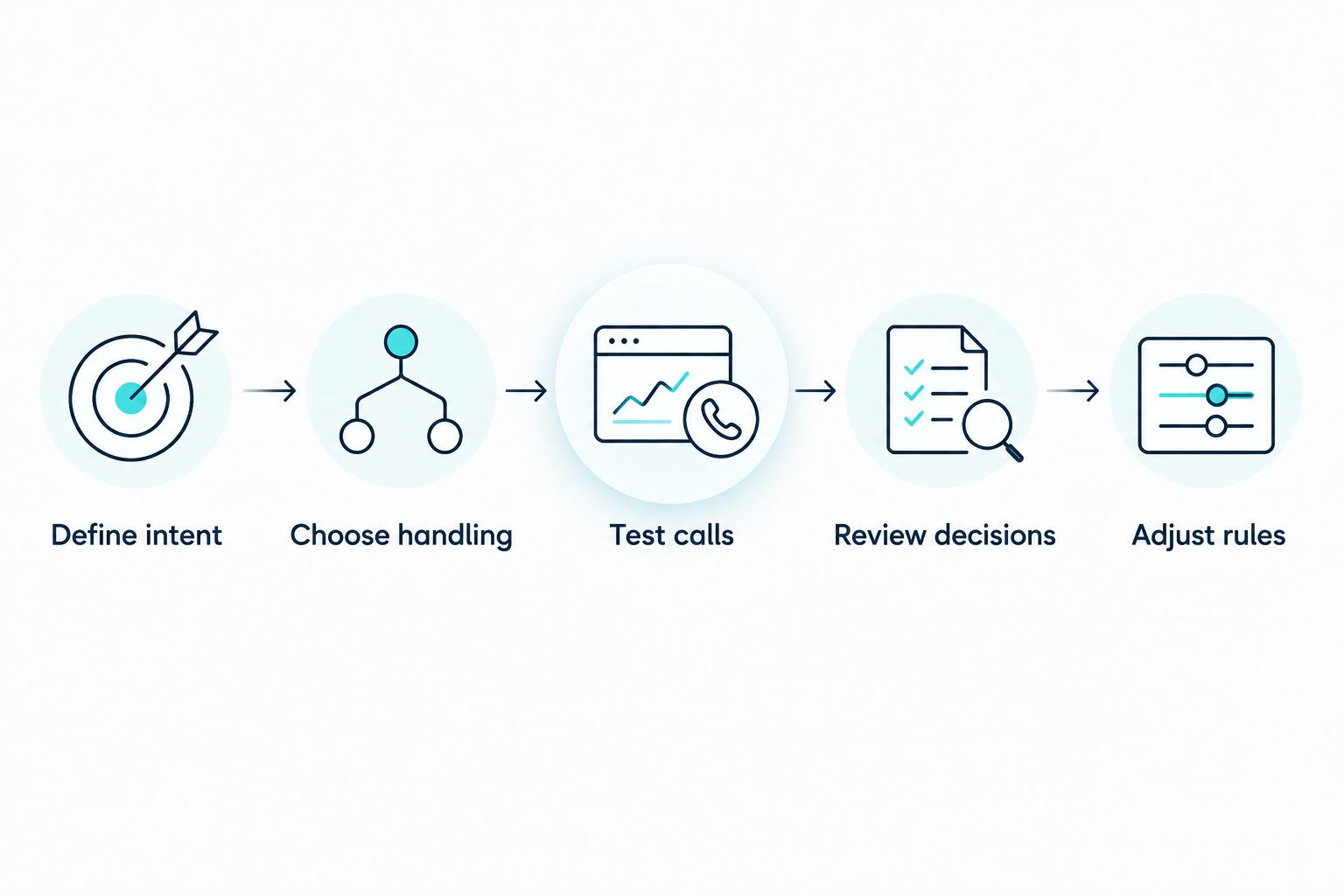
Test the caller journey, not just the final spam label. Use fictional inquiries and authorized test calls. Write down the expected outcome first so you can compare the observed behavior with your business rule.
- Define intent. List the calls your business wants: new inquiries, existing-customer questions, appointment requests, and relevant business contacts. Separately identify unwanted solicitation categories.
- Choose handling. Decide which cases deserve staff attention, which can become a message, and which should end without further action. Keep uncertain cases separate from confirmed unwanted calls.
- Test calls. Try a clear customer request, an obvious sales pitch, and an ambiguous inquiry. Include a caller who needs a question repeated rather than treating hesitation as evidence of spam.
- Review decisions. Check what happened to each call and why. Confirm whether staff were interrupted, whether a usable message remained, and whether a genuine inquiry still had a route forward.
- Adjust rules. Fix the rule behind an incorrect outcome, then repeat the relevant test. Do not expand blocking simply because an ambiguous example was inconvenient.
Make your 2026 acceptance test include a legitimate caller from an unfamiliar number. Also check what happens when an unwanted caller asks directly for a staff member. A configuration that transfers every request for the owner has not solved the interruption problem.
Keep the test focused on observed actions. A convincing conversation is useful, but it does not prove that blocking, message handling, or transfer rules work as intended.
What should you ask an AI receptionist provider?
Ask the provider to show a call rejected before answering and a call screened after answering. If only one is supported, that distinction belongs in your buying decision. Do not let the word blocking cover both without explanation.
Request plain-English answers to these questions:
- Which service makes the blocking decision?
- Can your team manage exclusions without contacting support?
- What happens to a call labeled uncertain?
- Does a blocked or screened call create a record you can inspect?
- Can you correct an incorrect decision and change the rule?
- Does receptionist handling require a separate phone integration or configuration?
For your 2026 evaluation, insist on seeing the proposed setup rather than a different configuration used in a sales demonstration. Keep a short record of the agreed behavior. It gives your team a clear reference when an actual call takes an unexpected route.
Where does lead management fit after call screening?
Spam handling decides what deserves attention. Lead management determines what happens to a genuine opportunity afterward: capturing contact details, qualifying the inquiry, following up, and arranging an appointment.
AL IntelliFlow is best for service-based businesses seeking lead capture, follow-up, and appointment-booking workflows. Those confirmed lead-management capabilities do not establish phone-level spam blocking or a built-in voice receptionist. Receptionist capabilities require separate verification of integrations and configuration.
AL IntelliFlow presents its business growth platform through three roles: Strategist, Connector, and Operator. That positioning covers planning, customer engagement, and operational workflows; it should not be read as evidence of a specific call-blocking mechanism.
Keep the distinction practical. When a genuine inquiry survives screening, someone or something must own the next step. Confirm how the contact enters your workflow and who follows up before assuming that answering the phone has solved lead handling.
FAQ
Can an AI receptionist block spam calls before they ring?
An AI receptionist can support pre-ring blocking only when the connected phone service provides that control. Conversation screening happens after answering and is not the same as rejecting a call before it connects.
Can an AI receptionist tell whether a caller is a salesperson?
An AI receptionist can assess the caller's stated purpose when conversation screening is supported and configured. Treat an unclear answer as a reason for clarification or review, not automatic proof of spam.
Will spam screening block real customers?
Incorrect screening rules can exclude legitimate inquiries. Keep a review route for uncertain calls and test genuine requests from unfamiliar numbers before enabling stricter blocking.
Is caller ID enough to identify spam calls?
Caller ID alone does not establish a caller's identity or intent because displayed numbers can be spoofed. Combine supported phone-system controls with purpose-based screening rather than relying only on the displayed number.
Can I stop spam callers from being transferred to my team?
You can prevent those transfers when your receptionist setup supports screening and routing rules for unwanted solicitations. Confirm that asking for the owner does not automatically bypass the screening rule.
Does AL IntelliFlow include spam-call blocking?
AL IntelliFlow's confirmed capabilities cover lead capture, qualification, follow-up, appointment booking, and routine workflows. Verify separate receptionist integrations and configuration before expecting spam-call blocking.
What's the best way to test an AI receptionist's spam filter?
Test a genuine inquiry, an unwanted solicitation, and an ambiguous request against outcomes you define in advance. Inspect the actual routing or blocking decision, not just how natural the conversation sounds.
One last thing
An unfamiliar caller is not an unwanted caller. That distinction belongs in your screening rules before you enable automatic rejection. Otherwise, the same system intended to protect your time can obstruct a new customer trying to reach you.
Review uncertain outcomes as part of your normal intake process. The useful question is not merely whether spam was stopped, but whether a legitimate inquiry still reached the next appropriate step.
Related guides
- Screen calls before they reach your team
- Transfer calls to a live person
- Move a missed call toward a booked appointment
Explore AL IntelliFlow and start its free 14-day trial to evaluate lead capture, follow-up, and appointment-booking workflows for your service business.