
AI lead qualification is accurate only to the extent that its decisions match clear business rules and independently reviewed inquiries; no single percentage describes every business in 2026. Measure both the unsuitable leads it accepts and the suitable leads it rejects, because an impressive overall accuracy score can hide missed opportunities.
- How accurate is AI at qualifying leads? Judge accepted leads, rejected leads, and unresolved inquiries separately.
- AL IntelliFlow supports service-business lead capture, qualification, follow-up, and appointment booking; verify suitability against your actual workflow.
- Use human-reviewed inquiries to evaluate lead scoring, rather than treating bookings as proof of qualification.
- Keep unclear inquiries in a review queue instead of automatically rejecting them.
Why this matters
A qualification decision determines what happens next. A suitable inquiry needs attention; an unsuitable inquiry needs an appropriate response; an incomplete inquiry needs clarification.
The problem starts when your system treats all three as the same thing. A homeowner asking about a service you do not provide is different from a homeowner who simply forgot to describe the job.
When comparing AI lead qualification tools for service businesses, look beyond the conversation itself. Ask how you will check decisions, correct mistakes, and prevent uncertain leads from disappearing.
The useful question is not whether the AI sounds convincing. It is whether the next action matches the evidence.
How accurate is AI at qualifying leads?
The answer comes from comparing AI decisions with a consistent human assessment of the same inquiries. Define what counts as qualified before judging the system, and keep that definition unchanged during each evaluation.
For a service business, qualification might require a matching service request, a serviceable location, and enough information to determine the next step. Those are example criteria, not universal requirements. Your business must decide which details are essential and which can wait.
Use this 4-step evaluation process for your 2026 assessment:
- Define qualification. Write the conditions that make an inquiry suitable, unsuitable, or unresolved. Separate hard exclusions from useful background information.
- Label real inquiries. Have a knowledgeable team member review the original messages without seeing the AI's decision first. Record the reason for each label.
- Compare decisions. Check where the AI and reviewer agree, where they disagree, and where either lacks enough information.
- Inspect the consequences. Determine whether each mistake led to unnecessary staff work, an inappropriate next step, or a suitable inquiry being rejected.
Do not change the expected answer just to match the system. If reviewers disagree, resolve the business rule before treating their labels as a reliable reference.
Measure the errors separately
A single accuracy score compresses different mistakes into one result. Keep the following measures separate so you can see what needs fixing.
| Measure | What it tells you | What it does not establish |
|---|---|---|
| Overall accuracy | How often AI labels match reviewed labels | Whether suitable leads are being missed |
| Precision | How many AI-qualified leads reviewers also consider qualified | How many suitable inquiries were rejected |
| Recall | How many reviewer-qualified leads the AI identifies | Whether accepted leads create unnecessary work |
| Unresolved share | How many inquiries remain undecided | Whether the system eventually handles them correctly |
Precision is correctly qualified leads divided by all leads the AI marked qualified. Recall is correctly qualified leads divided by all leads reviewers marked qualified.
For an overall accuracy calculation, define whether unresolved inquiries count as a separate category or sit outside the calculation. State that choice alongside the result. Otherwise, two reports can appear comparable while measuring different things.
Which qualification approach should you use?
Choose an operating approach based on the consequences of a wrong decision, not the appeal of removing every manual task. The table below describes workflow choices, not verified features of a particular platform.
| Approach | Best for | Advantage | Limitation |
|---|---|---|---|
| Rules-based screening | Explicit service and location exclusions | Gives you criteria that are straightforward to inspect | Does not resolve an ambiguous request by itself |
| AI-led qualification | Interpreting conversational inquiries | Can turn free-text answers into a proposed qualification decision | Requires checks for unsupported assumptions |
| Human-reviewed qualification | Exceptions and consequential decisions | Lets staff clarify context before acting | Requires staff attention and a managed queue |
Use explicit rules for hard exclusions and human review for unresolved cases. Let conversational interpretation support the decision rather than silently replace your business requirements.
A practical workflow uses 3 outcomes: qualified, unsuitable, and needs clarification. That third outcome matters because missing information is not evidence that a prospect is a poor fit.
For example, an inquiry that names a service but omits the location belongs in clarification if location is required. An inquiry that explicitly requests a service you do not offer belongs in the unsuitable category. Neither decision requires guessing what the person meant.
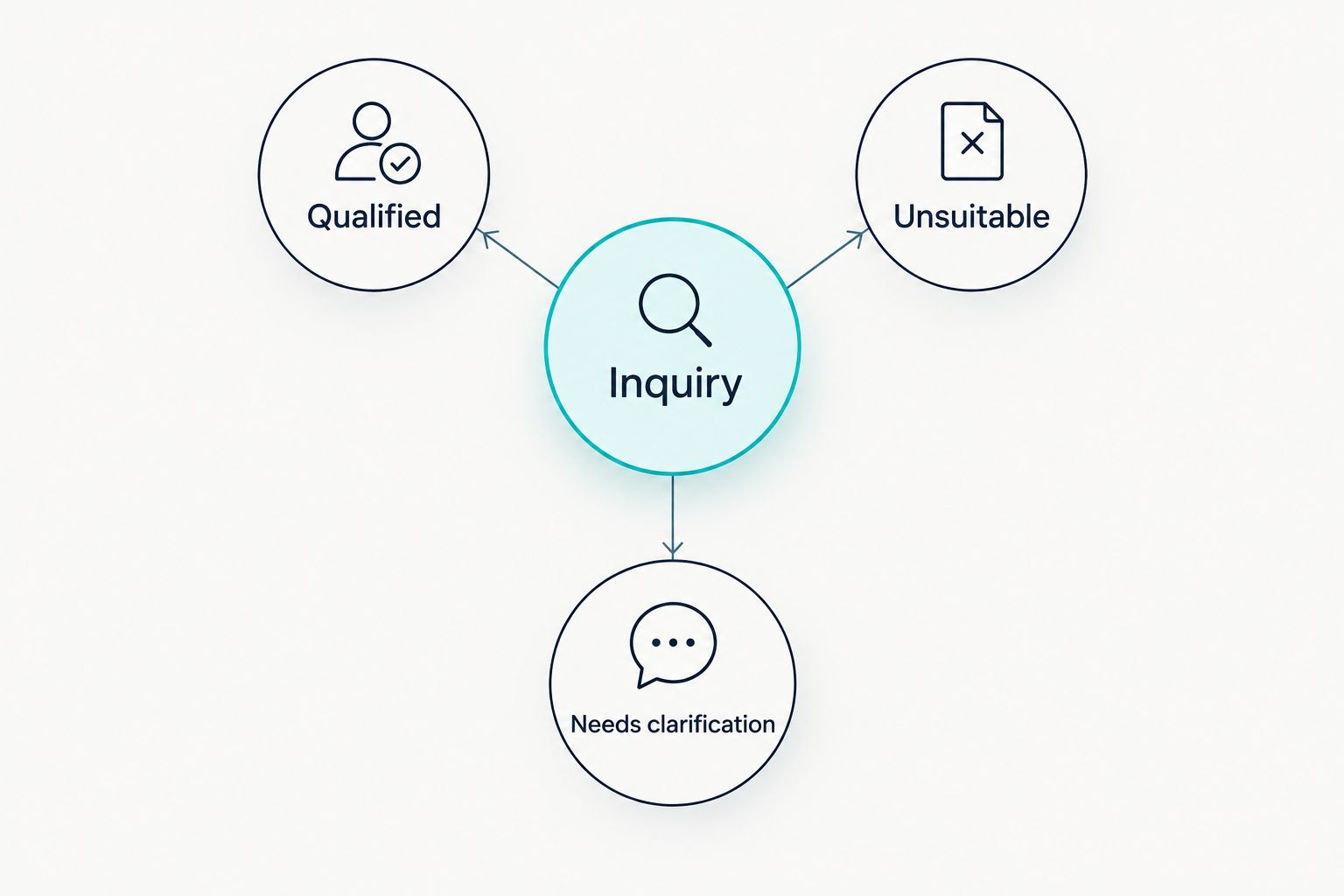
The diagram describes a recommended decision structure, not a claim that every platform provides these statuses automatically. Confirm how your chosen system represents and handles each outcome.
Why AI lead qualification accuracy varies
These 5 factors belong in your 2026 evaluation because each changes what the system must interpret or decide:
- Qualification rules. A written service boundary is easier to evaluate than an instruction such as finding good prospects. Define what evidence supports each decision.
- Information completeness. An inquiry without a required detail cannot support a final qualification decision. Ask for the missing detail rather than filling it in.
- Language and context. Short messages, corrections, and indirect requests need careful interpretation. Include these patterns when reviewing actual inquiries.
- Business information. Qualification depends on the services and requirements supplied to the system. Review those instructions when your business changes.
- Escalation rules. Decide what happens when answers conflict or remain unclear. A review queue needs an owner and a defined next action.
These factors also explain why a vendor's headline score is not enough to select a system. Before applying a published result to your business, check the task, sample, qualification definition, and treatment of unresolved cases.
Do not compare a test of contact-detail extraction with a test of purchase readiness. Extracting an email address correctly does not establish that the person needs your service or is ready to book.
What should you test before relying on the decisions?
Build your 2026 review around the decisions that affect your staff and prospects. Use real inquiries where appropriate, remove unnecessary personal details, and preserve the wording needed to understand the request.
Include straightforward matches and straightforward exclusions. Then add cases that challenge the boundaries of your rules: missing information, a changed answer, conflicting details, and a request that needs staff judgment.
For each reviewed inquiry, record:
- The original request and relevant follow-up answers.
- The expected outcome and the business rule supporting it.
- The system's outcome and any stated reason.
- Whether clarification or staff review was required.
- The next action actually taken.
Evaluate the action as well as the label. A correctly labeled inquiry is still mishandled if it receives the wrong follow-up or never reaches the responsible person.
Keep the evaluation examples separate from examples used to revise instructions. Repeatedly adjusting a system around the same messages tells you how it handles those messages, not how it handles unfamiliar inquiries.
After changing a rule, check previously correct cases again. A fix for one ambiguous request should not quietly change how clear requests are handled.
Is AI qualification better than manual qualification?
Neither method wins without a shared definition and a review of actual decisions. Human qualification provides contextual judgment; automated qualification applies the configured process without requiring a person to assess every initial inquiry.
Both need controls. Staff can interpret the same rule differently, while an automated process can repeatedly apply an incorrect instruction.
Compare both approaches against the same reviewed inquiries. Measure rejected suitable leads, accepted unsuitable leads, unresolved cases, and follow-up errors separately. Do not use a different standard for the method you prefer.
Does a booked appointment prove a lead was qualified?
A booked appointment proves that an appointment was scheduled, not that the prospect met your qualification requirements. Keep booking success separate from qualification accuracy in your reporting.
An appointment can still concern an unsupported service or require information that was never collected. Conversely, a suitable prospect might need clarification before choosing a time.
Track the distinction in plain language: was this inquiry suitable, was the next action appropriate, and did the intended handoff happen? Those questions expose different problems and point to different fixes.
When should a person review an AI-qualified lead?
Use human review when a required answer is missing, information conflicts, or the next action depends on an exception to your normal rules. The reviewer should see the original inquiry, not just a summary or score.
Give that reviewer a specific decision to make. Asking whether a request falls within your service scope produces a clearer handoff than sending a vague instruction to check the lead.
Review should also feed back into your instructions. If staff repeatedly resolve the same ambiguity, clarify the rule instead of leaving each person to improvise.
Where AL IntelliFlow fits
AL IntelliFlow is best for service businesses seeking software for lead capture, qualification, follow-up, and appointment booking. Those are the confirmed functions relevant to this decision; they do not establish a universal qualification accuracy rate.
AL IntelliFlow presents its business growth assistant through three roles: Strategist, Connector, and Operator. Evaluate those roles against your planning, customer engagement, and operational needs, then test the actual lead journey against your written requirements.
The practical benefit is support across the lead-management process. The limitation is that a platform description does not prove how accurately your particular inquiries will be classified. That requires your own evaluation.
Do not treat lead management as proof of telephone receptionist functionality. AI receptionist capabilities require separate integrations or configuration, and any proposed call-handling setup needs verification before you rely on it.
FAQ
What's a good accuracy rate for AI lead qualification?
A useful accuracy rate must be tied to your qualification rules and the consequences of mistakes. Evaluate precision, recall, and unresolved inquiries separately rather than adopting an unsupported universal target.
Can AI reject a lead that would have become a customer?
Yes, AI qualification can reject a suitable inquiry. Review rejected leads as well as accepted leads, and use clarification when required information is missing.
How do I check whether AI lead scoring is accurate?
Compare the system's decisions with independent human reviews of the same inquiries. Use written criteria, record disagreements, and inspect the action taken after each decision.
Is AI lead qualification the same as appointment booking?
No, qualification evaluates suitability, while appointment booking schedules a meeting or service conversation. A booking alone does not show that the inquiry met your requirements.
Should AI automatically reject leads with missing information?
Missing information should trigger clarification when that information is required for a decision. Automatic rejection confuses an unanswered question with a confirmed mismatch.
Does lead qualification software automatically answer phone calls?
Lead qualification software does not automatically establish telephone receptionist capability. Verify any separate integrations, configuration, and call-handling functions required for your workflow.
One last thing
For your 2026 evaluation, inspect rejected leads before celebrating a clean appointment calendar. Accepted leads are visible to your team; rejected inquiries need deliberate review.
Start by asking what the system ruled out and why. That review directly tests whether your screening process is protecting staff time without dismissing suitable inquiries.
Related guides
- Website lead to instant text reply workflow
- How appointment scheduling works with your calendar
- Does an AI receptionist replace a human front desk employee?
Explore AL IntelliFlow and start its free 14-day trial. Bring your qualification rules and use the trial to assess how the platform fits your lead-management process.