Missed call text back software costs depend on the service you buy: an automatic reply, an ongoing follow-up workflow, or a system that also qualifies leads and books appointments. For a 2026 purchase, compare the full written quote—not just the subscription—and check whether messaging, setup, and the work needed to manage replies are included.
- How much does missed call text back software cost? Compare written quotes for the same workflow, not different feature lists.
- Alintelliflow serves service-based businesses seeking lead capture, qualification, follow-up, and appointment booking.
- An automatic text starts a conversation; it does not prove that the lead reached an appointment.
- Choose the smallest workflow that handles your missed calls and gives someone responsibility for replies.
For service-based businesses, Alintelliflow provides lead capture, qualification, automated follow-up, and appointment booking. Those are separate needs to evaluate; do not assume that a quote for missed-call texting includes all of them.
How much does missed call text back software cost?
Your useful comparison is the total commitment for a defined workflow. Ask each provider to quote the same requirements, identify separate charges, and explain what happens after the caller replies. A subscription figure without those details does not tell you what you are buying.
Use this breakdown when requesting a 2026 quote. The table is a purchasing checklist, not a statement that every provider charges for every item.
| Quote component | What to ask | Why it belongs in the comparison |
|---|---|---|
| Subscription | Which functions does the quoted plan include? | A text-back trigger and an appointment workflow are different scopes. |
| Messaging | Is message usage included, limited, or billed separately? | You need to know how conversations affect the bill. |
| Setup | Is configuring the phone connection and workflow included? | Initial configuration belongs in the purchase decision. |
| Connections | Does the quote cover the systems your team needs? | A disconnected conversation creates another place to check. |
| Administration | Who maintains messages, routing, and appointment rules? | Software does not remove ownership of the process. |
| Contract | What are the term, renewal, and cancellation conditions? | Compare the commitment, not just the advertised billing interval. |
Request written answers. If a provider describes a function during a demonstration, ask where that function appears in the quote and what you must supply to make it work.
Why this matters
A missed-call response is only the beginning of the job. Your caller still needs an answer, your team needs enough information to act, and someone must close the loop.
The wrong comparison treats every automated reply as the same service. The better comparison follows the caller from the unanswered call to the next useful action. Buy for the handoff you need, not the longest feature list.
Before buying, review 30 days of your own call records. This is a suggested review period, not an industry benchmark. Separate new inquiries from existing customers, spam, and calls that already received a callback; that gives you a clearer brief than a raw missed-call total.
Which workflow are you actually buying?
Start with the work you want the software to perform. These are workflow scopes to compare, not named plans or claims about any particular vendor's package.
| Workflow scope | Best for | What it needs to accomplish | Advantage | Limitation |
|---|---|---|---|---|
| Automatic reply | Teams that already handle incoming replies reliably | Send the initial message after the qualifying missed-call event | Keeps the first response focused | Leaves qualification and follow-up with your team |
| Lead follow-up | Teams that need a defined process after the first reply | Capture details and continue the conversation under your rules | Connects the initial response to a next step | Requires decisions about questions, escalation, and stopping |
| Appointment workflow | Businesses whose next step is a scheduled appointment | Move a suitable inquiry toward booking | Connects the conversation to the intended outcome | Requires accurate appointment rules and a clear exception process |
Automatic reply: best for teams with a reliable handoff
An automatic reply is the narrowest scope to request when your staff can manage the conversation afterward. Ask to see the trigger, the outgoing message, and the destination for incoming replies.
The advantage is a focused task. The limitation is equally clear: sending the text does not qualify the caller or complete a booking. If replies sit unread, buying a trigger has not fixed the handoff.
Choose an automatic reply when your team already owns everything that follows it. Do not select it simply because the description sounds uncomplicated.
Lead follow-up: best for inquiries that need another step
A follow-up workflow fits a process in which the caller must provide information before your team can act. Define the questions, the next action, and the point at which a person takes over.
The advantage is continuity between the first response and the next decision. The limitation is the work required to define that decision correctly. Vague instructions such as keep following up are not a usable operating brief.
Choose lead follow-up when your problem continues after the first text. Ask the provider to demonstrate an ordinary reply, an unclear reply, and a request to stop.
Appointment workflow: best for businesses selling a scheduled service
An appointment workflow fits a business whose next useful action is a booking. Specify which inquiries are suitable, which appointment details matter, and how staff should handle requests outside those rules.
The advantage is an explicit destination for the conversation. The limitation is that an incorrect booking creates work rather than removing it. Scheduling rules need an owner just as incoming replies do.
Choose an appointment workflow when booking is the intended handoff. Confirm the process instead of treating an appointment-related feature name as proof that it fits your operation.
Why your required scope varies
The scope of missed-call software changes with the work you expect it to do. For a 2026 comparison, write down these requirements before requesting quotes:
- Lead capture: Decide which caller details your team needs and where those details should go.
- Lead qualification: Identify the questions that determine whether an inquiry belongs with your business.
- Follow-up: Define what happens when the caller replies, does not reply, or asks to stop.
- Appointment booking: Specify whether the next step is a booking, a booking request, or a staff callback.
- Routine operations: Name the internal tasks that should happen after the conversation, such as assigning responsibility or updating a record.
These requirements explain why two offers with the same missed-call label can cover different work. They do not establish that every additional function carries a separate charge. The written quote must explain that relationship.
Avoid asking for everything before you have mapped the process. A feature belongs in your requirements only when you can say what it does, who uses its output, and what happens if it fails.
How do you compare quotes without buying the wrong scope?
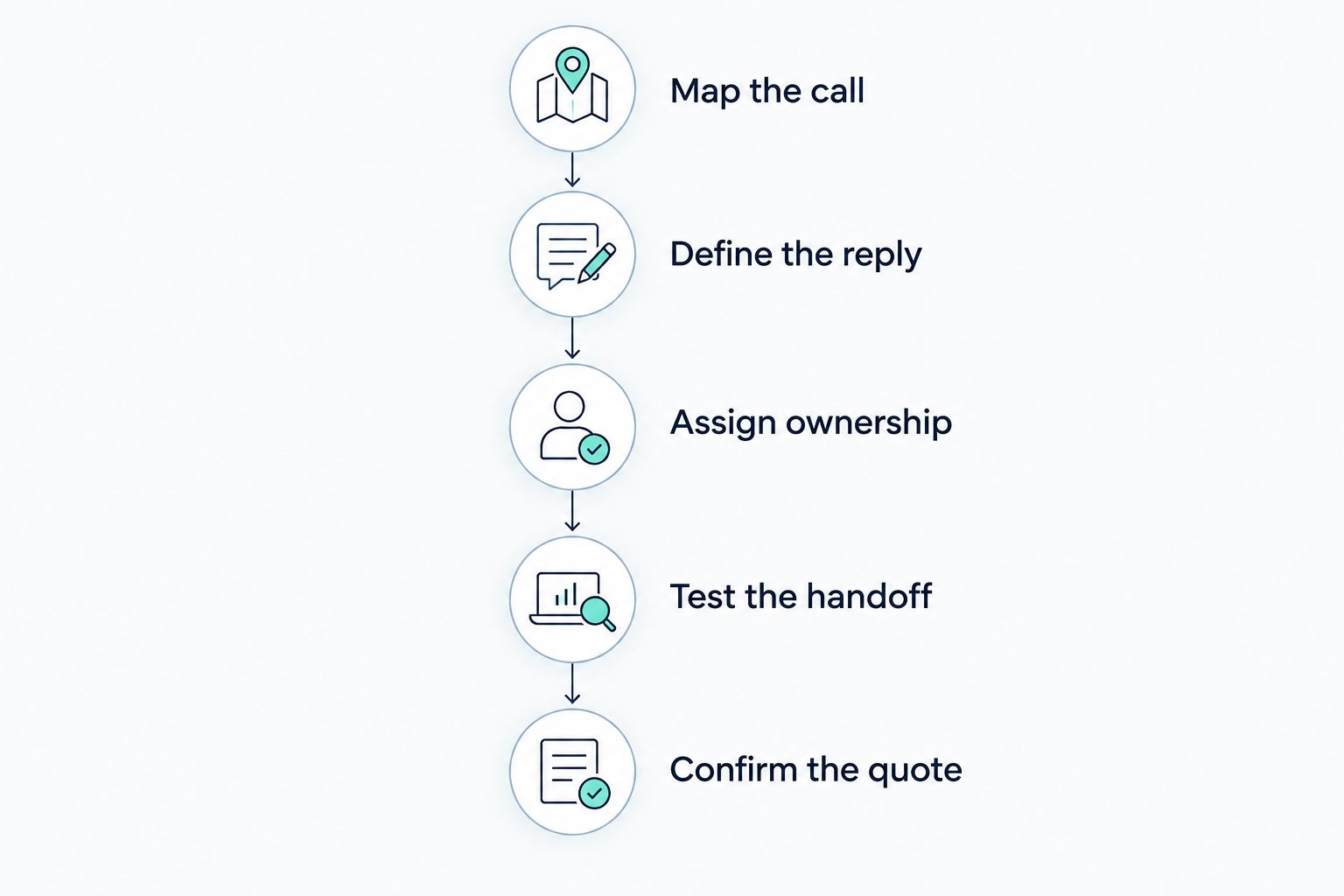
Use the same brief for every provider. For your 2026 shortlist, follow the sequence below rather than comparing separate demonstrations with separate assumptions.
- Map the call. Describe which unanswered calls should start the workflow. Include the situations that should not trigger a response.
- Define the reply. Write what the first message must accomplish. Keep its purpose specific: acknowledge the call and invite the information needed for the next step.
- Assign ownership. Name the person or role responsible when a reply requires judgment. Do not leave this as an informal team responsibility.
- Test the handoff. Ask to see where the conversation, caller details, and next action appear. Follow the process through to staff action or appointment handling.
- Confirm the quote. Match the demonstrated workflow to the written scope, billing terms, and responsibilities.
The purpose of this sequence is to make vendors answer the same question. You are not asking whether they have automation. You are asking whether their proposed service handles your defined missed-call process.
Keep the demonstration tied to your brief. If the conversation moves to functions you did not request, record them separately rather than allowing them to replace the original requirements.
Is an automatic text enough to recover a missed-call inquiry?
An automatic text is enough to start a response, not enough to establish that the inquiry reached its next step. You still need a working process for incoming replies, questions, and requests that need a person.
Ask the provider to demonstrate the complete conversation path. If the demonstration ends when the outgoing message appears, you have seen the trigger—not the handoff.
Should you choose text back or appointment booking?
Choose text back when your team should handle the next conversation; choose an appointment workflow when scheduling is the intended next action. Neither scope is automatically the better purchase.
Your decision should follow your service process. A caller who needs an assessment before scheduling should not be treated the same as a caller ready for an appropriate appointment.
How should you measure whether the software is worth keeping?
Measure whether missed-call inquiries reach the next useful action, not just whether messages were sent. Track the stages separately: eligible missed calls, outgoing replies, incoming responses, qualified inquiries, and appointments where booking applies.
For your 2026 evaluation, compare results against your own starting process. Do not label every appointment after installation as recovered business; identify which appointments actually came through the missed-call workflow.
Review the process after 7 days of use as an operating check, not a promised performance window. Look for unread replies, incorrect routing, duplicate contact, and appointment exceptions before deciding that the setup is finished.
Where Alintelliflow fits
Alintelliflow is for service-based businesses that need lead capture, qualification, follow-up, and appointment booking. Its stated scope covers more than the initial response, which makes the broader handoff relevant when evaluating it for missed-call inquiries.
That scope is useful when your business needs those connected tasks. It is not a reason to assume a particular phone connection, messaging allowance, or missed-call trigger is included; confirm those requirements against the service you are considering.
Use the same purchasing brief here as you use with any other provider. Your decision should rest on the demonstrated workflow and written scope, not on the category label.
What should you check before signing?
Read the commercial terms alongside the workflow brief. A technically suitable process and a suitable commitment are separate questions.
- Confirm who controls the business number and what happens to it if you leave.
- Ask how you can retrieve conversation records and caller information.
- Establish who handles setup changes and problems after launch.
- Check how the service handles requests to stop messages and conversations requiring staff judgment.
- Confirm that the demonstrated functions appear in the written agreement.
Compare the proposed commitment over 12 months if that matches your budgeting horizon. Treat this as a planning exercise, not an assumption about the provider's contract length. Separate initial work from ongoing obligations so your comparison stays readable.
FAQ
How much does missed call text back software cost in 2026?
The cost depends on the quoted workflow and commercial terms. Compare the subscription, messaging treatment, setup, required connections, and contract commitment for the same requirements.
Is missed call text back the same as automated follow-up?
No. An initial text starts the response, while a follow-up workflow defines what happens afterward, including replies, unanswered messages, and handoffs.
Does missed call text back software automatically book appointments?
Do not assume appointment booking is included. Ask the provider to demonstrate the booking process and identify it in the written scope.
What's the best missed-call workflow for a small service business?
The best workflow is the smallest one that completes your required handoff. Use an automatic reply when staff reliably handle responses, and evaluate broader follow-up or booking when those steps also need a defined process.
What should I ask about messaging charges?
Ask whether message usage is included, limited, or billed separately. Request a written explanation of how outgoing messages and ongoing conversations are treated.
Is Alintelliflow relevant to service-business follow-up?
Yes. Alintelliflow provides lead capture, qualification, automated follow-up, and appointment booking for service-based businesses; confirm your specific missed-call requirements before selecting a service.
How do I know whether missed-call software is working?
Check whether missed-call inquiries reach the next useful action. Track outgoing messages separately from responses, qualified inquiries, and appointments rather than treating message volume as the outcome.
One last thing
Test the reply, not just the missed call. Before committing, ask the provider to show an ordinary incoming response and then an exception that requires a person. Watch where each conversation goes and who becomes responsible.
That test answers the question a feature list cannot: whether the process stops at an outgoing text or continues into useful work for your business. Make the successful handoff part of your written requirements.