An AI receptionist’s cost in 2026 depends on the provider’s billing model, your usage, and the work you expect it to handle; get a written quote for your actual workflow rather than budgeting from a headline subscription. Check whether setup, usage beyond the allowance, follow-up messages, and connections to your existing systems are included. Compare the full bill for the same workload—not subscriptions with different coverage.
- How much does an AI receptionist cost? Compare a written quote covering subscription, usage, setup, and ongoing support.
- Alintelliflow serves service businesses that need lead capture, follow-up, and appointment booking.
- Require billing examples for your normal workload and a busier billing cycle before choosing a provider.
- Test appointment booking and exception handling, not just whether the receptionist answers a call.
Why this matters
A receptionist purchase is a workflow decision before it is a subscription decision. You need to know what happens after someone makes contact: whether their details are captured, their request is qualified, and someone takes responsibility for the next step.
Alintelliflow provides lead capture, qualification, automated follow-up, and appointment booking for service-based businesses. Alintelliflow serves service businesses that need lead capture, follow-up, and appointment booking. Assess those functions against your needs; they do not, by themselves, establish which call channels, usage allowances, or system connections a particular purchase includes.
For your 2026 buying decision, define the result you want before requesting a proposal. An accurate message and a completed appointment are different deliverables. Your comparison should keep that distinction visible.
How much does an AI receptionist cost in 2026?
The useful answer is the total charge for a defined workload. Ask each provider to separate recurring service, measured usage, implementation, and optional work so you can compare equivalent proposals.
Use the same brief for 3 provider quotes. That is a practical comparison exercise, not a market benchmark: specify your contact channels, recorded workload, required questions, appointment rules, and handoff process in each request.
| Quote component | What to request in writing | What to check |
|---|---|---|
| Recurring service | The billing period and included functions | Whether the quoted scope matches your brief |
| Usage | The unit measured and any included allowance | Which interactions count toward the bill |
| Additional usage | The rule for work beyond the allowance | Whether you receive alerts or can set limits |
| Implementation | The tasks covered before launch | Who configures questions, routing, and booking rules |
| System connections | The exact calendar or customer system involved | Whether connection work is included |
| Ongoing changes | The process for updating business rules | Whether changes require separate work |
| Ending service | Notice requirements and data access | What you retain when the service stops |
Request a total for your normal workload and a separate total for a busier workload. Supply figures from your own records rather than asking a salesperson to choose assumptions for you.
Do not compare one quote that includes appointment handling with another that only records a message. First make the scope equivalent. Then compare the billing terms and the demonstrated result.
Separate launch work from recurring work
Your launch proposal should identify the information you must supply and the configuration the provider will complete. That includes your service descriptions, qualification questions, appointment restrictions, and escalation instructions where those functions are required.
Keep this work separate from the recurring service in your comparison. A proposal that leaves launch responsibilities vague does not give you a clear basis for approving the project.
Check what the billing unit actually measures
Ask whether usage is measured by calls, connected time, conversations, messages, or another defined unit. Then ask how transfers, repeat contacts, incomplete interactions, and follow-up activity are treated.
Do not assume that an unsuccessful interaction is excluded from billing. Require the rule in writing and use it when reviewing the example bill.
Which receptionist scope should you pay for?
Choose the scope around the next action your business needs. If staff only need accurate messages, direct booking adds rules to maintain without necessarily solving your immediate problem.
The following comparison describes purchasing requirements, not verified features of a particular provider. Confirm each capability in a demonstration and in the written scope.
| Scope | Best for | Practical benefit | Limitation to check |
|---|---|---|---|
| Message capture | Businesses that want staff to make the final decision | Gives staff contact details and a stated request | Staff still own the response and scheduling |
| Lead qualification | Businesses that need to assess fit before responding | Collects answers to defined eligibility questions | Exceptions need an escalation route |
| Appointment booking | Businesses with clear scheduling rules | Moves an eligible request toward a calendar booking | Incorrect rules can produce unsuitable appointments |
| Follow-up workflow | Businesses that need to continue the conversation | Gives an unanswered or unfinished inquiry a next step | Stop rules and staff ownership must be clear |
Best for simple intake: message capture with a named staff owner. Require a readable summary and a clear destination for it. The limitation is straightforward: your team still has work to do after the message arrives.
Best for screening: qualification with explicit exception handling. Write down what makes an inquiry suitable before configuring questions. Do not let unanswered questions silently become disqualifying answers.
Best for direct scheduling: appointment booking with controlled calendar rules. Require the provider to demonstrate appointment types, availability restrictions, and conflict handling. A booking is useful only when your business can honor it.
Best for continuing inquiries: follow-up with clear stop conditions. Decide when automated contact stops and when staff take over. Without those rules, responsibility for the conversation stays unclear.
Why AI receptionist cost varies
A meaningful 2026 comparison starts with a fixed scope. Use these factors to structure your quote request rather than treating every provider’s offer as interchangeable:
- Workload: Supply your recorded contact volume and ask how the provider measures billable usage. Separate routine demand from the busier workload you want covered.
- Contact channels: Specify whether you need phone handling, website inquiries, messages, or a combination. Ask for the billing treatment of each required channel.
- Qualification rules: List the questions needed to establish service fit. Include the action required when a caller gives an unclear answer.
- Scheduling requirements: Identify appointment types, staff calendars, service areas, and restrictions relevant to your business. Ask what the proposed configuration covers.
- Follow-up responsibilities: Define which inquiries need another contact attempt and who owns the conversation afterward. Require explicit stop and handoff rules.
- Implementation and support: Separate initial configuration from later changes. Ask who maintains business information and how problems are reported.
These factors are also your scope-control checklist. If a proposal adds a function you did not request, ask what business problem it addresses before accepting it.
The reverse matters too. If a proposal removes qualification or follow-up to simplify the offer, identify the staff work that remains. A smaller software scope is not the same thing as a completed workflow.
How do you check a quote before signing?
Use a repeatable buying process instead of choosing from a polished demonstration. In 2026, your acceptance criteria should describe observable outcomes: accurate details, correct routing, suitable bookings, and a documented handoff.
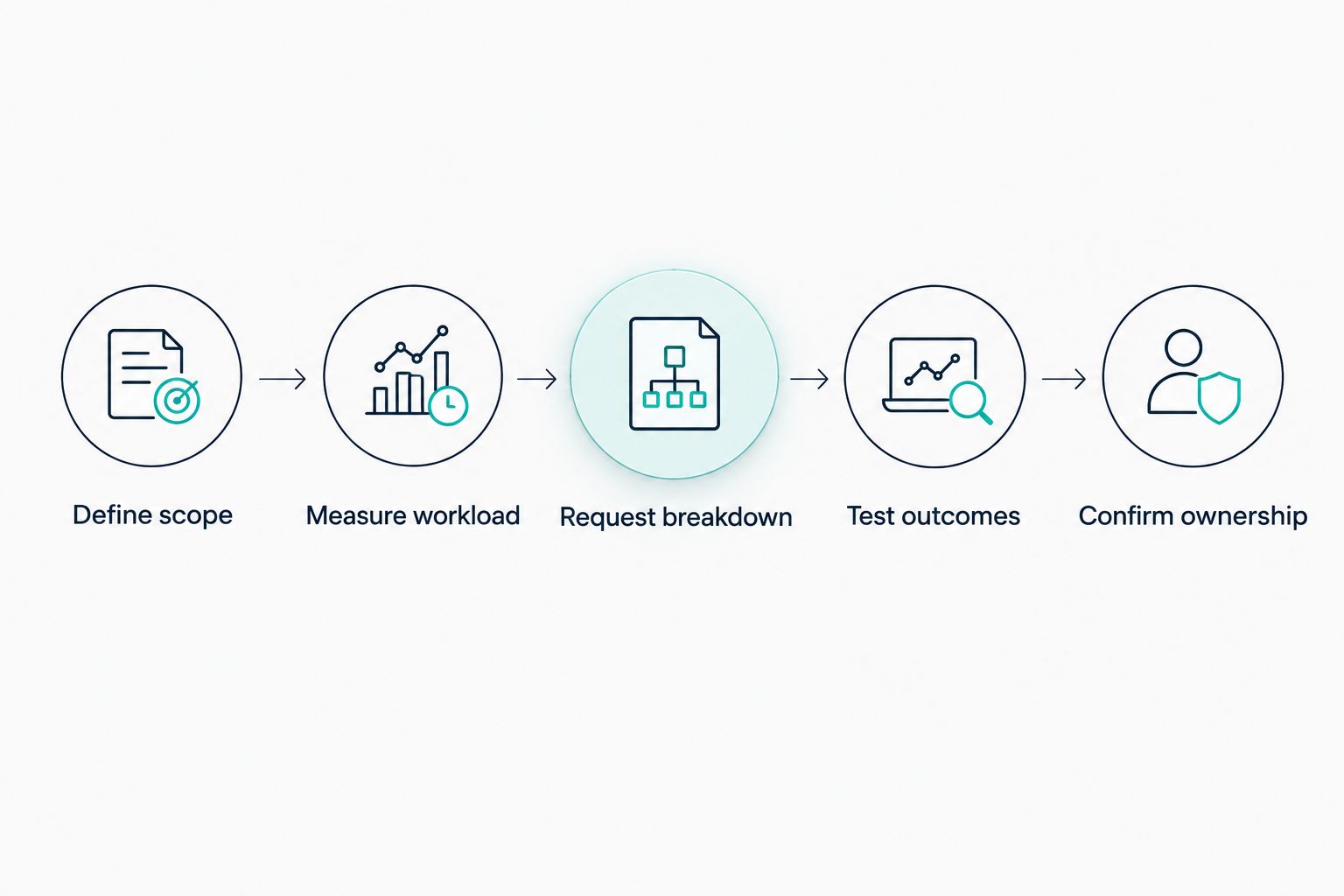
- Define scope. Write the contact channel, information required, and desired next action. State which decisions must remain with your team.
- Measure workload. Review 1 complete billing cycle of your own contact records. Keep the underlying records so every provider works from the same brief.
- Request breakdown. Ask for recurring charges, usage rules, launch responsibilities, and ongoing changes to be separated. Require a worked billing example using your workload.
- Test outcomes. Run 5 test calls or equivalent interactions before accepting the workflow. Record what happened rather than relying on a verbal assurance.
- Confirm ownership. Assign responsibility for reviewing errors, updating information, handling exceptions, and taking over conversations.
The written scope connects these steps. If a demonstration shows a function that the proposal does not include, request clarification before treating it as part of the purchase.
What should the test interactions cover?
Make your tests representative of work the service will actually receive. Use a straightforward inquiry, an unsuitable request, an unclear answer, an appointment request, and a request needing staff involvement.
For each interaction, check the captured details, the next action, and whether the receptionist stayed within your rules. If booking is outside your chosen scope, replace the appointment test with another relevant intake scenario.
A fluent conversation is not the acceptance criterion; a correct outcome is. Keep the results alongside the proposal so unresolved problems do not disappear between the demonstration and launch.
What should you ask about changes?
Ask how you update service information, scheduling rules, and escalation instructions. Find out who makes those changes and how you confirm that they took effect.
Also establish what happens when the workflow stops working as intended. Your team needs a reporting route and an operational fallback, not just access to a configuration screen.
Is an AI receptionist cheaper than a human receptionist?
Compare equivalent responsibilities before drawing that conclusion. Software handling defined intake tasks is not the same purchase as a staff member handling reception, exceptions, and unrelated office work.
List the duties you want covered, then identify which remain with staff under the proposed software scope. Include configuration, review, and exception handling in that assessment. Do not treat automation as staff replacement unless the remaining work supports that decision.
Do I need appointment booking or just message capture?
Choose appointment booking when your scheduling rules are clear and suitable inquiries can proceed without a staff decision. Choose message capture when someone must review the request before committing the business.
Neither option removes the need for ownership. A message needs someone responsible for responding; a booking needs rules that keep unsuitable appointments off the calendar.
How do I know whether the receptionist is worth buying?
Judge the purchase against the problem you defined. Track whether required details arrive correctly, inquiries reach the right person, and eligible appointment requests reach the intended next step.
For a 2026 purchase, establish those measures before launch. Compare actual outcomes with your starting records, and keep staff time spent correcting problems visible rather than counting every automated interaction as a success.
FAQ
How much does an AI receptionist cost in 2026?
An AI receptionist’s cost in 2026 depends on the provider’s billing model, your usage, and the required workflow. Request a written total that separates recurring service, usage, implementation, and optional work.
What should an AI receptionist quote include?
An AI receptionist quote should identify the service scope, billing unit, usage allowance, implementation responsibilities, and terms for ongoing changes. Request a billing example based on your actual workload.
Can I compare AI receptionists using the subscription alone?
No—compare the full bill for the same workload and required functions. A subscription comparison is incomplete when one proposal includes booking or follow-up and another only captures messages.
How many interactions should I test before choosing a receptionist?
Use 5 test calls or equivalent interactions as a practical acceptance check. Cover routine intake, unsuitable requests, unclear answers, booking where required, and staff escalation.
Is an AI receptionist better than a human receptionist?
Choose by responsibility, not by a blanket ranking. Assess which defined tasks the software will handle and which decisions, exceptions, and office duties remain with staff.
What does Alintelliflow help service businesses do?
Alintelliflow helps service businesses capture and qualify leads, automate follow-up, book appointments, and streamline routine operations. Confirm the required channels, configuration, and commercial terms before purchasing.
Should I pay for booking if my staff approve every appointment?
Prioritize accurate intake and staff handoff when your team must approve every appointment. Direct booking only fits your workflow when the system can follow the approval and scheduling rules you require.
One last thing
Ask the provider to demonstrate a request it should not book. That test exposes the boundaries of the workflow: whether it declines appropriately, captures useful information, or sends the request to a person.
Your final 2026 decision should rest on the written scope and demonstrated outcomes. For Alintelliflow or any other provider, a successful routine interaction is only part of the assessment; the exception path deserves the same attention.