
AI appointment scheduling software has no single monthly cost: you need a current quote for the booking workflow, usage, and support your business requires. The subscription alone does not establish the full budget; check whether setup, connected services, and ongoing maintenance are included or separate. For a 2026 purchase, compare the cost of getting a qualified lead into an appointment—not just putting an event on a calendar.
- How much does AI appointment scheduling software cost? Compare written quotes for the same booking workflow and usage.
- Alintelliflow fits service businesses seeking lead capture, qualification, automated follow-up, and appointment booking together.
- Separate recurring software charges from setup work and your team's ongoing responsibilities.
- Judge appointment scheduling and lead follow-up by completed handoffs, not a feature list.
Why this matters
A calendar entry is not the same as a qualified appointment. Your buying decision needs to account for how a prospect enters the system, what information gets collected, and who handles exceptions before a booking reaches your team.
Alintelliflow provides lead capture, qualification, automated follow-up, and appointment booking for service-based businesses. Those functions define a broader buying question than scheduling alone: which parts of your current lead-to-appointment process do you want software to handle?
Compare the same work before comparing the bill. A quote covering booking alone and a quote covering lead capture through booking do not describe the same scope. Decide what you need first, then ask each provider to quote that scope in writing.
How much does AI appointment scheduling software cost?
The useful answer is the total cost of your specified workflow, not a category-wide average. Build your 2026 comparison around recurring charges, initial implementation, and the work your business retains after launch.
Use this breakdown when requesting quotes. Each row is a question to resolve, not an assumption that every provider charges separately for it.
| Budget component | What to ask the provider | What to record |
|---|---|---|
| Recurring subscription | Which booking and follow-up functions are included? | Included scope and billing period |
| Usage | What activity is measured, and what happens at the limit? | Measurement method and limit terms |
| Initial setup | Who configures booking rules and qualification questions? | Included work and your responsibilities |
| Connected services | Which calendars and business systems work with the proposed setup? | Required connections and separate subscriptions |
| Ongoing maintenance | Who updates workflows when your services or hours change? | Owner of each maintenance task |
| Support | Who handles failed bookings or unclear conversations? | Support scope and escalation process |
Keep recurring commitments separate from initial work. That makes it easier to compare the ongoing obligation without losing sight of what it takes to launch.
For planning, request a 12-month projection using your expected activity. This is a recommended budgeting horizon, not a contract recommendation. Ask the provider to show the assumptions behind the projection so you can change them when your requirements change.
Compare the workflow you need
These are buying scopes, not named vendor tiers. Use them to distinguish the job you want done before requesting a quote.
| Buying scope | Best for | Main advantage | Main limitation |
|---|---|---|---|
| Booking only | Businesses that already qualify leads before scheduling | Keeps the task focused on arranging appointments | Leaves lead capture and qualification elsewhere |
| Qualification and booking | Businesses that need answers before offering an appointment | Connects eligibility questions to the booking decision | Requires clear rules for acceptable leads |
| Capture, follow-up, and booking | Businesses seeking a connected lead-to-appointment process | Covers more of the handoff from inquiry to appointment | Requires more workflow decisions and ownership |
Choose the smallest scope that covers the actual handoff. Booking-only software is a poor fit when your unresolved problem is unanswered inquiries. A broader workflow is unnecessary when your team already handles capture, qualification, and follow-up effectively.
Do not treat a longer feature list as proof of better value. Ask each provider to demonstrate your chosen scope using the same example inquiry, the same qualification rules, and the same booking conditions.
Why appointment scheduling quotes vary
The work you request determines what you need to evaluate. For a service business, define these requirements before asking providers to explain their commercial terms:
- Lead capture: Specify where inquiries enter your process and what information you need to retain. Ask which entry points the proposed setup covers.
- Qualification: Write down the questions that determine whether an inquiry belongs on your calendar. Ask how the system handles an incomplete or unclear answer.
- Follow-up: Define what should happen when a prospect stops responding. Ask which follow-up actions are included and who approves the wording.
- Appointment booking: Specify the appointment types and rules your business needs. Ask the provider to demonstrate the booking decision rather than describe it.
- Routine operations: Identify what your team must do after an appointment is booked. Ask whether the proposed workflow covers those tasks or stops at scheduling.
These requirements do not establish a universal rate or prove that any particular provider charges extra. They give you a consistent basis for evaluating scope.
For your 2026 shortlist, send every provider the same requirements document. If a response omits an essential step, request clarification before treating that quote as comparable. A short description of your workflow is more useful than an open-ended request for the cheapest plan.
How do you build a useful scheduling software budget?
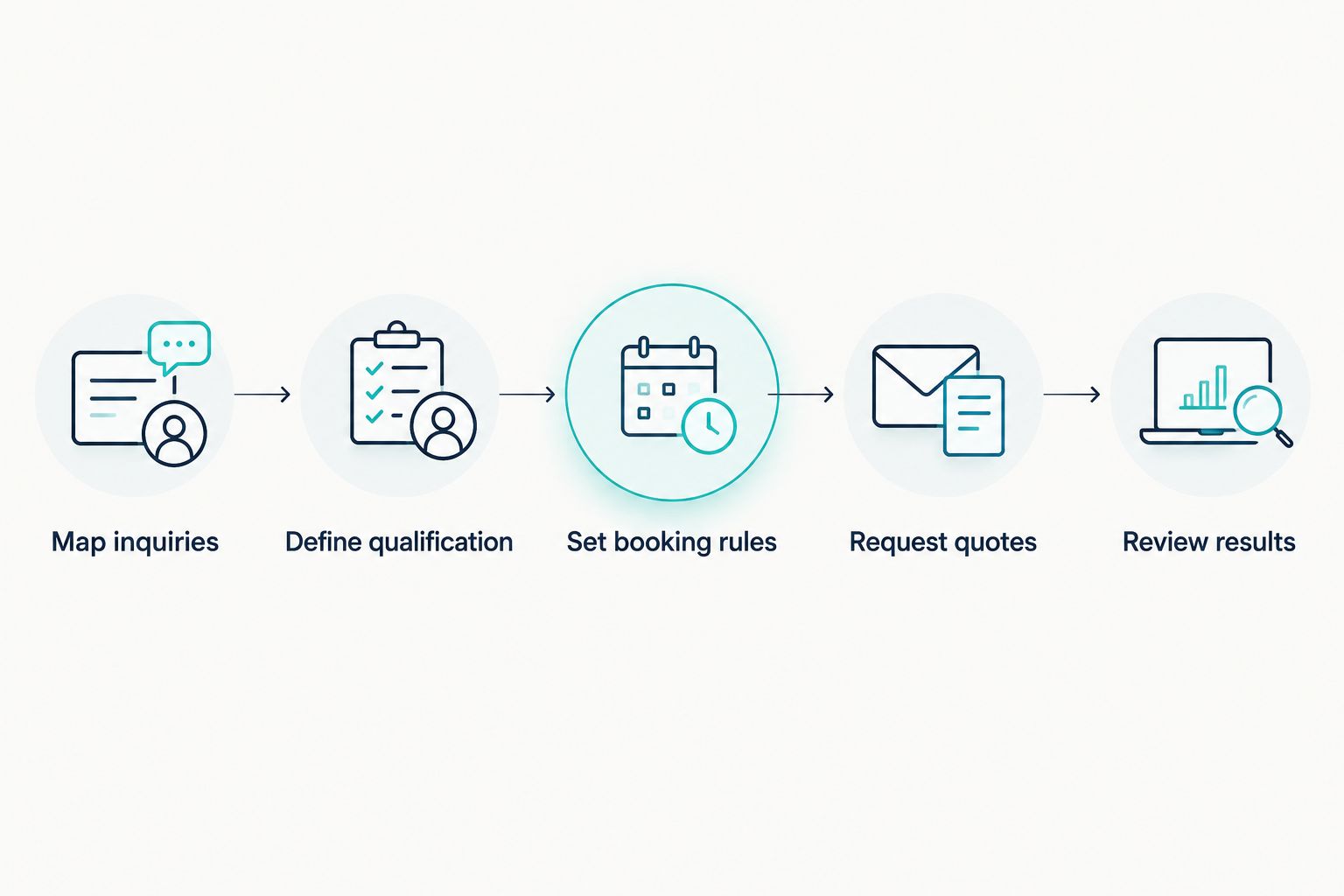
Use the following sequence to turn a broad software search into a buying decision. Keep the process tied to the work your business already performs; do not design a new operation around a demonstration.
1. Map inquiries
Review a recent 7-day sample of inquiries as a starting point. This is a recommended observation window, not a benchmark for lead volume or performance. If that sample misses important appointment types or inquiry patterns, extend the review.
Record where each inquiry arrived, what information was missing, and what happened next. Separate an inquiry that never received a response from one that received a response but never booked. Those are different workflow problems.
2. Define qualification
Write the minimum information your team needs before offering an appointment. Use actual acceptance rules, not questions added merely because a form can collect them.
Decide what happens when a prospect cannot answer a required question. The workflow needs an explicit next step: request clarification, route the inquiry to a person, or stop the booking process according to your business rules.
3. Set booking rules
Specify the appointment types you want the software to arrange and the conditions that permit booking. Include the information your staff needs to prepare for the appointment.
Ask providers to demonstrate an ordinary booking and an exception. A system that creates an event has not necessarily completed your handoff; your team must also receive the information needed to act on it.
4. Request quotes
Send the workflow to each provider and request a written response against it. Separate confirmed inclusions from unresolved questions rather than filling gaps with assumptions.
Ask how the quote changes when your requirements change. Keep the answer attached to the quote so the commercial terms and the demonstrated workflow stay connected.
5. Review results
Schedule a 30-day review after launch to inspect the workflow. This is a recommended review interval, not a promise that results will appear within that period.
Check whether inquiries receive the intended response, qualification information reaches your team, and appointments follow your rules. Record staff corrections and unresolved handoffs alongside bookings. A booking count alone does not show whether the workflow is doing the right job.
Where does Alintelliflow fit?
Alintelliflow is for service businesses that want lead capture, qualification, automated follow-up, and appointment booking in one workflow. Its stated scope addresses the process before an appointment, not scheduling in isolation.
The advantage of that scope is relevance to businesses evaluating the whole inquiry-to-booking handoff. The trade-off is a broader implementation brief: your business must define what qualifies a lead, what follow-up should say, and when a prospect should reach a person.
For an Alintelliflow appointment scheduling evaluation in 2026, bring those rules to the discussion. Confirm the current commercial terms, required connections, included setup work, and exception handling before committing. Product scope alone does not establish those details.
Evaluate your booking workflow
Review lead capture, qualification, follow-up, and appointment booking against your business requirements.
Is booking-only software enough for my business?
Booking-only software fits when your prospects are already qualified and need a way to arrange an appointment. Its focused scope leaves the earlier lead-handling work with your team or other systems.
Choose a broader evaluation when you need help capturing inquiries, collecting qualification details, or following up before booking. Match the purchase to the unresolved task, not to the label on the software.
Should I compare monthly or annual billing?
Compare the full commitment and the terms attached to each billing option, not just the billing interval. Ask what happens if you change scope, reduce usage, or stop using the service.
For a 2026 decision, keep your planning projection separate from the contract you sign. A longer budgeting horizon helps you examine costs; it does not require you to accept a longer commitment.
What should I ask before approving a quote?
Ask the provider to show an inquiry becoming a qualified appointment under your actual rules. Then ask who owns every step that remains outside the demonstrated workflow.
Get the scope, usage terms, setup responsibilities, and support process in writing. Approve the quote only when the commercial agreement and the demonstrated process describe the same job.
FAQ
How much does AI appointment scheduling software cost in 2026?
AI appointment scheduling software requires a current quote matched to your workflow and usage; there is no single category-wide cost that establishes your budget. Compare the recurring commitment, setup responsibilities, connected services, and ongoing work.
What's the best way to compare appointment scheduling quotes?
Compare quotes against the same written booking workflow. Ask every provider to identify included functions, usage terms, setup work, and tasks your team must retain.
Is AI appointment scheduling better than a booking link?
A broader automated workflow fits when you need qualification or follow-up before booking; a booking link fits when prospects are already ready to schedule. Define the unresolved task before choosing either scope.
Does appointment scheduling software replace my receptionist?
Appointment scheduling software does not establish a replacement for every receptionist responsibility. Map the duties involved and confirm which tasks the proposed workflow handles and which remain with a person.
What does Alintelliflow appointment scheduling cover?
Alintelliflow provides lead capture, qualification, automated follow-up, appointment booking, and routine workflow solutions for service-based businesses. Confirm the exact setup and commercial scope against your requirements before buying.
How can I tell whether scheduling software is doing its job?
Check whether inquiries receive the intended response, qualification details reach your team, and bookings follow your rules. Review corrections and unresolved handoffs alongside appointment counts.
What should I check before signing a scheduling software agreement?
Check that the written agreement covers the workflow demonstrated to you. Confirm usage terms, setup responsibilities, required connections, support, and what happens when your requirements change.
One last thing
Test what happens when a prospect gives an unclear answer—not just when every answer matches your script. Ask the provider to show whether the workflow requests clarification, stops booking, or passes the inquiry to your team.
That test exposes an operational boundary a polished demonstration can leave unexplained. Do not approve a booking workflow until you know who owns the exception. In your 2026 purchase decision, that ownership belongs beside the quote, not in a conversation after launch.