
You see ROI from an AI receptionist when the additional profit it generates, plus verified operating savings, exceeds the total cost of deploying and running it. The timeline depends on your missed opportunities, booking conversion, job margins, and payment cycle—not the date the software goes live. Count setup work and ongoing oversight, and do not treat a booked appointment as collected revenue.
- How long does it take to see ROI from an AI receptionist? Until attributable profit and verified savings exceed total costs.
- AL IntelliFlow fits service businesses seeking lead capture, qualification, follow-up, and appointment booking in one workflow.
- Measure completed, paid work—not just answered calls or booked appointments.
- Separate operating break-even from recovering setup costs.
Why this matters
A receptionist can improve responsiveness before it produces a financial return. A captured inquiry is useful, but it does not prove that your business earned more money. The customer still needs to qualify, book, attend, and pay.
For a service business evaluating automation in 2026, the useful question is not simply whether calls get answered. It is whether the changed workflow produces additional profitable work or reduces an expense you actually incur.
AL IntelliFlow provides lead capture, qualification, follow-up, and appointment booking software for service-based businesses. Assess those capabilities against the specific gap in your process, rather than assuming that any automation purchase will pay for itself.
How long does it take to see ROI from an AI receptionist?
An AI receptionist reaches financial payback when its cumulative attributable benefit exceeds its cumulative cost. Your timeline therefore follows a chain: deployment, inquiry handling, qualification, booking, completed service, and payment. A booking dashboard measures only part of that chain.
Use these steps to establish your own payback date:
- Record the baseline. Document how inquiries currently become qualified leads, bookings, completed jobs, and payments. Separate new prospects from existing customers.
- Define the intervention. Identify the inquiries the receptionist will handle and the tasks that remain with your team. Record when the new workflow starts.
- Track attributable outcomes. Connect handled inquiries to completed, paid jobs. Exclude duplicate contacts and business that would have booked anyway.
- Calculate the net benefit. Add contribution profit from incremental jobs and verified operating savings, then subtract deployment and operating costs.
- Check cumulative payback. Compare the accumulated benefit with all costs incurred since implementation, including setup work.
The first profitable operating period is not necessarily the payback date. You can cover ongoing expenses while still recovering the effort and expense of getting the system running.
Follow the money, not just the booking
For your 2026 evaluation, follow each prospect through these stages: Capture, Qualify, Book, Complete, Collect. Capture and booking demonstrate activity; completion and collection establish the basis for financial measurement.
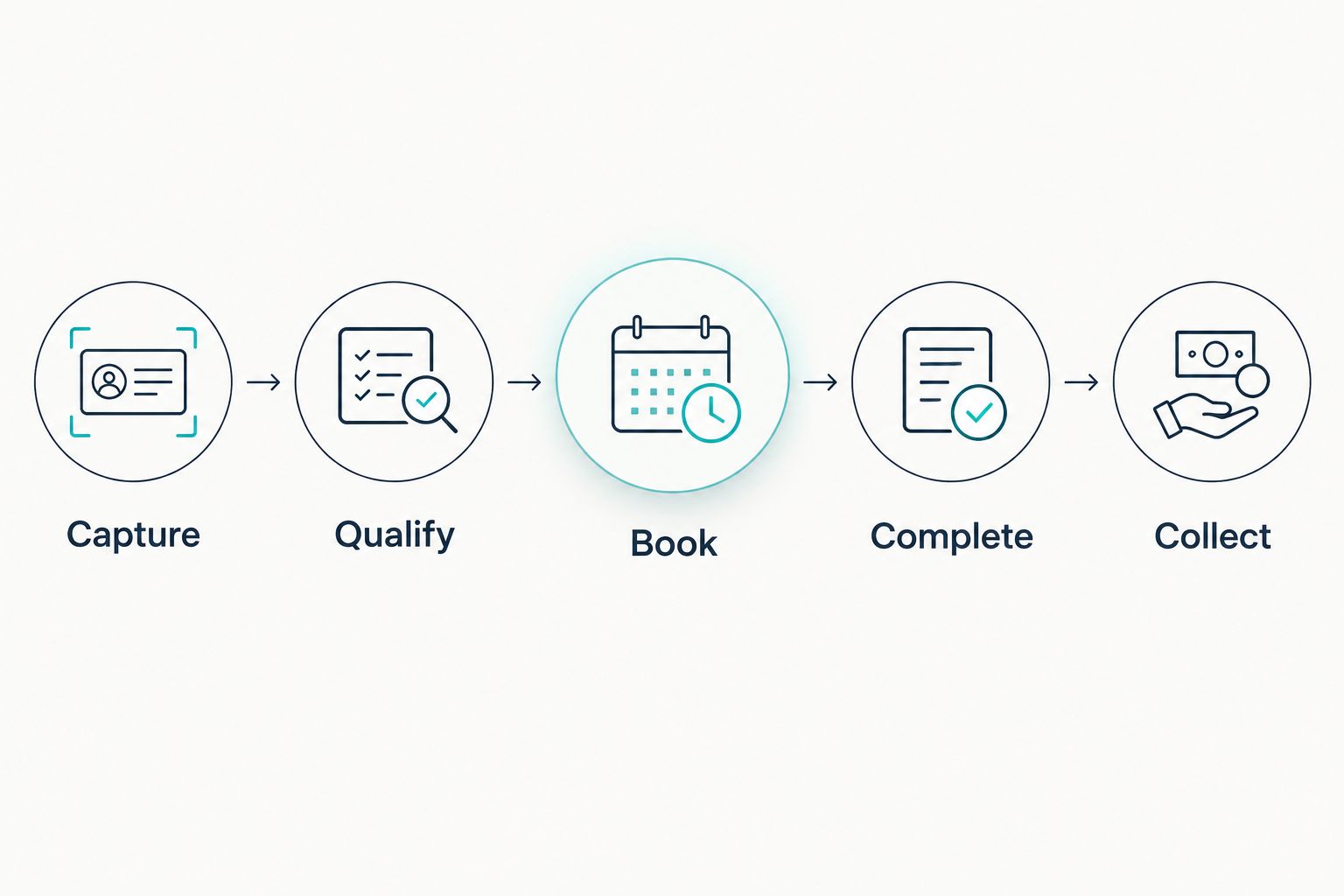
Keep the connection between stages visible. If your booking record cannot be matched to the completed job and payment, you cannot confidently credit the receptionist with that financial result.
Operating break-even versus full payback
Different definitions of ROI produce different answers. Decide which question you are asking before judging the timeline.
| Measurement | What it tells you | Best for | Limitation |
|---|---|---|---|
| Operating break-even | Attributable benefit covers ongoing operating costs | Deciding whether continued use makes financial sense | Does not establish recovery of setup costs |
| Full payback | Cumulative attributable benefit covers cumulative deployment and operating costs | Evaluating the original investment | Depends on complete historical cost records |
| Cash payback | Collected cash benefit covers cash outlays | Managing available cash | Does not fully describe staff time or unpaid commitments |
For an ongoing-use decision, examine operating break-even. For an investment decision, examine full payback. If cash is tight, check cash payback separately rather than assuming that booked work funds the system.
Keep the accounting treatment consistent. Revenue earned and cash collected answer different questions, so do not switch between them midway through your evaluation to produce a better-looking result.
How to calculate AI receptionist ROI without overstating it
Start with the value of additional work, not the full value of every booking the system touches. The important distinction is incremental: would your business have secured that work without the new workflow?
Use contribution profit instead of headline revenue
Contribution profit from incremental work = attributable collected revenue − variable delivery costs. Those delivery costs include expenses that arise because you perform the additional work, such as job-specific materials or labor.
Counting the entire invoice as a benefit overstates the amount available to cover the receptionist. A service with a large invoice and substantial delivery costs can contribute less than a smaller, higher-margin job.
Use your actual job records. If service categories have different margins, calculate their contributions separately instead of assigning every appointment the same financial value.
Separate time saved from money saved
Less administrative work is an operational benefit. It becomes a direct cash saving when it reduces an actual expense, such as paid overtime or an outsourced task.
If an employee remains on the same payroll, do not report the full value of their freed time as a payroll reduction. Track that time separately and identify what the employee does with it.
If the freed capacity produces additional profitable work, count the resulting contribution once. Do not count the same benefit as both recovered labor value and additional job profit.
Include the work required to run the system
Your cost record should include deployment effort, ongoing service costs, staff review, corrections, and any connected expenses required for the workflow. Use incurred costs rather than the most favorable version of a proposal.
A 2026 ROI review should also distinguish temporary setup work from recurring oversight. That distinction helps you understand whether an expensive initial period is a deployment issue or an ongoing operating problem.
Keep a compact evidence record
For each handled inquiry, retain its source, handling date, qualification outcome, booking status, completion status, payment status, and attributable contribution. Add a clear reason when you classify a job as incremental.
You do not need an elaborate dashboard to make this useful. You need records that let you trace a claimed benefit back to an actual customer outcome.
Why AI receptionist payback time varies
Your return depends on the work available to recover and your ability to fulfill it. These factors determine the calculation:
- Recoverable inquiry volume. Missed or delayed inquiries create an opportunity to improve handling. Duplicate contacts, irrelevant calls, and existing bookings do not carry the same incremental value.
- Qualification and conversion. Capturing a contact is not enough. The inquiry needs to fit your services and progress toward a completed job.
- Contribution per completed job. Delivery expenses determine how much each additional job contributes toward covering the receptionist.
- Service capacity. Extra demand cannot become completed work unless your team has the availability and resources to fulfill it.
- Payment timing. A completed service and a collected payment can occur at different points. Your cash-payback calculation follows collection.
- Deployment and oversight. Setup work, staff review, corrections, and ongoing operating expenses all belong in the cost calculation.
More inquiries alone do not establish a shorter payback period. The relevant measure is additional contribution after costs. Keep that distinction visible when comparing periods or deciding whether to expand the workflow.
Which workflow should you evaluate first?
Choose the workflow that addresses an observable failure in your current process. Do not automate every customer interaction simply because the software can handle routine tasks.
The following approaches solve different problems. Their benefits depend on whether those problems exist in your business.
| Approach | Best for | Potential benefit | Constraint to check |
|---|---|---|---|
| Reception coverage | Businesses with unanswered inquiries | Captures requests that need a response | Captured contacts still require qualification and conversion |
| Lead follow-up | Businesses with qualified prospects awaiting a next step | Moves unresolved inquiries toward a decision | Repeated contact does not establish incremental sales |
| Appointment booking | Businesses with scheduling friction | Turns suitable inquiries into scheduled service | Bookings need capacity, attendance, and completion |
| Routine task automation | Businesses with repetitive administrative work | Releases staff capacity | Released time is not automatically a cash saving |
Start where you can identify the failure and measure the outcome. If inquiries already receive prompt responses but appointments remain unconfirmed, focus your evaluation on the booking process rather than response speed alone.
AL IntelliFlow is best suited to service businesses seeking lead capture, follow-up, and appointment booking workflows. Its stated scope matches those tasks; your financial decision still depends on whether they address a documented business problem.
Before committing, confirm the capabilities your intended receptionist workflow requires. Ask about inquiry channels, scheduling connections, staff handoffs, and handling rules rather than assuming the product description establishes every implementation detail.
What should you measure before deciding whether to continue?
Use the same definitions before and after deployment. Changing what counts as a qualified lead or completed job makes the comparison less useful.
For your 2026 review, examine these evidence categories:
- Process outcomes: inquiries captured, qualification outcomes, bookings, and successful handoffs.
- Customer outcomes: attendance, completed work, payments, and corrections required.
- Financial outcomes: incremental contribution, actual expense reductions, and total operating costs.
- Implementation outcomes: staff review work, unresolved exceptions, and recurring adjustments.
Compare equivalent service categories and inquiry sources where possible. Record changes in advertising, opening hours, staffing, or capacity so you do not automatically credit the receptionist for unrelated business changes.
Continue based on demonstrated benefit, not activity alone. If inquiries are captured but fail to reach completed work, identify the broken stage before expanding coverage.
Can an AI receptionist pay for itself immediately?
An AI receptionist pays for itself only when attributable benefit covers the relevant costs. Capturing a valuable inquiry immediately does not establish payback if the work remains uncompleted or unpaid.
Treat an early booking as evidence that the process is functioning. Verify its financial contribution before describing it as a return.
Does saving staff time count as ROI?
Staff time savings count as operational value, but they are not automatically cash savings. Report actual expense reductions separately from capacity released for other work.
When freed capacity produces additional contribution, document that outcome. Avoid assigning a financial value to unused time simply to make the investment appear profitable.
Should you judge ROI by booked appointments or completed jobs?
Completed, paid jobs provide stronger evidence of financial return than booked appointments. Bookings are useful for diagnosing the process, but cancellations, no-shows, and delivery costs affect the final benefit.
Track both. Use appointments to locate friction and paid work to assess payback.
FAQ
How long does it take to see ROI from an AI receptionist?
You see ROI when attributable profit and verified operating savings exceed deployment and operating costs. Your timeline depends on conversion, delivery margins, capacity, and payment timing.
Is an AI receptionist worth it for a small service business?
An AI receptionist is financially worthwhile when its attributable benefit exceeds its total cost. Start with a documented gap in inquiry handling, follow-up, or booking rather than assuming automation itself creates value.
What is the difference between break-even and payback?
Operating break-even means ongoing benefits cover ongoing costs; full payback means cumulative benefits cover cumulative costs, including deployment. A system can reach operating break-even before recovering its initial investment.
Can I count every appointment the AI receptionist books as new revenue?
No, a booked appointment is not collected revenue or proof of incremental business. Verify completion, payment, delivery costs, and whether the customer would have booked without the new workflow.
Does an AI receptionist need to replace an employee to produce ROI?
No, an AI receptionist can produce ROI through incremental profitable work or verified expense reductions without replacing an employee. Time released on unchanged payroll should be reported separately from cash savings.
What should I track when evaluating AL IntelliFlow?
Track qualified leads, follow-up outcomes, booked appointments, completed work, and attributable contribution when evaluating AL IntelliFlow. Its stated role is lead capture, qualification, follow-up, appointment booking, and routine workflow support for service businesses.
How should I review AI receptionist ROI in 2026?
Review AI receptionist ROI in 2026 using consistent baseline definitions and records connecting inquiries to completed, paid work. Separate operating break-even, full payback, and cash payback so each result answers a clear financial question.
One last thing
The strongest ROI claim can be smaller than the booking dashboard suggests. Removing duplicate contacts, existing customers, uncompleted work, and delivery costs gives you a result you can actually use to make a decision.
Before your next review, choose a completed job and trace it backward to the original inquiry. If the records establish how the workflow changed the outcome, you have a useful measurement process. If they stop at the appointment, fix the evidence trail before expanding the deployment.