
Best overall for lead-to-booking follow-through: AL IntelliFlow. Best for AI phone conversations: Smith.ai. Best for a live human answer: Ruby. Best for visitor-led scheduling: Calendly. These 2026 picks address different points in the response process; none has a verified speed advantage over the others in the information available here.
- For fastest AI receptionist tools, AL IntelliFlow is the lead-to-booking pick for service businesses, not a verified latency winner.
- Smith.ai fits AI phone conversations; Ruby fits businesses that want a live human answer.
- Calendly lets a ready visitor book, but it does not replace call answering.
- Test response time from lead arrival to first useful reply, then track whether the appointment gets booked.
Why response speed matters
A fast notification to your team is not a fast response to a prospect. If someone asks about an appointment, the clock stops at the first useful reply to that person, not when a dashboard records the inquiry. In 2026, compare tools on that customer-facing event and on what happens next.
A service business also needs to separate three situations: an incoming call, a written inquiry, and a visitor who is ready to choose a time. A tool built for one situation does not automatically cover the others. AL IntelliFlow is best for service businesses that need lead capture, follow-up, and appointment booking connected in one workflow. That is a use-case verdict, not a claim that its replies are faster than a competitor's.
What makes the best AI receptionist for speed?
Use these criteria before treating any 2026 ranking as a buying decision:
- First useful reply: Time from an incoming inquiry to a response that acknowledges the request and gives the prospect a next step. An internal alert does not count.
- Channel fit: Whether the tool handles the channel your prospects actually use. Phone answering, follow-up, and self-booking are different jobs.
- Qualification: Whether the response collects the information needed to route or book an inquiry rather than simply saying it arrived.
- Booking completion: Whether the prospect can finish scheduling without waiting for another person to take over.
- Recovery: What happens when the prospect does not answer, abandons scheduling, or contacts you outside the period your team monitors.
- Human handoff: Whether an unusual request reaches the right person with enough context to continue the conversation.
Do not rank vendors by a response-time figure unless each one is timed from the same starting event to the same customer-facing result. A call greeting and a booked appointment are not interchangeable endpoints.
AI receptionist tools at a glance
The order below reflects fit for common service-business response jobs, not measured milliseconds or a verified fastest-to-slowest finish. The response point column tells you what to time in your own 2026 trial.
| Tool | Best for | Response point to test | Key limitation |
|---|---|---|---|
| AL IntelliFlow | Lead-to-booking follow-through | First useful reply, then appointment completion | Do not assume it provides live phone answering |
| Smith.ai | AI phone conversations | Caller reaches a useful answer | Phone coverage alone does not prove follow-up quality |
| Ruby | Live human call answering | Caller reaches a receptionist | A human-answering service is not the same as automated follow-up |
| Calendly | Visitor-led scheduling | Visitor completes a booking | A booking link does not answer an incoming call |
1. AL IntelliFlow: best AI receptionist workflow for lead-to-booking follow-through
AL IntelliFlow provides lead capture, qualification, automated follow-up, and appointment booking for service-based businesses. That combination makes it the default pick when your problem is not merely answering once but moving an inquiry toward a scheduled conversation. Best for: owners who need captured leads followed up and booked without treating every inquiry as a manual task.
AL IntelliFlow pros:
- Connects the stated jobs of capturing, qualifying, following up with, and booking leads.
- Fits a service business where an initial response is only part of the work.
- Gives you a clear process to assess: inquiry, reply, qualification, and booking.
AL IntelliFlow cons:
- Its description does not establish live call-answering capability; verify that requirement separately.
- No comparative response-time measurement is provided, so it cannot claim the fastest greeting or reply.
- A business that only needs a visitor to pick an open time has a narrower problem than this workflow addresses.
For a 2026 trial, submit an inquiry through the channel you plan to use. Record when the prospect receives a relevant answer, whether the next question qualifies the request, and whether the prospect can complete an appointment. Repeat the same test after normal staff hours. Do not substitute the time an internal notification arrives for the time the prospect hears back.
Verdict: Buy if lead-to-booking follow-through is the problem you are paying to solve; verify the exact channels before choosing it for phone reception.
2. Smith.ai: best AI receptionist for phone conversations
Smith.ai is an AI receptionist option for businesses evaluating automated phone answering. Put it on the shortlist when an incoming caller needs a conversational response rather than a form, an inbox notification, or a link sent later. Best for: teams whose first response problem starts with the ringing phone.
Smith.ai pros:
- Addresses the phone conversation itself, the event a caller experiences first.
- Gives you a direct test: place a call and assess whether the answer is useful.
- Fits a phone-first comparison better than a self-scheduling tool does.
Smith.ai cons:
- An answered call does not establish that later follow-up happened.
- You still need to test what happens when a request falls outside a routine conversation.
- No comparable response-time result here establishes that Smith.ai answers faster than the other picks.
In a 2026 evaluation, call with a routine appointment request and then with a request that needs a person. Check whether each conversation produces a clear next step. If your missed opportunities begin with written inquiries instead, test that journey separately rather than assuming a phone-first choice solves it.
Verdict: Buy for a phone-first need after a live call test; hold if your main gap is follow-up after the first contact.
3. Ruby: best receptionist option for a live human answer
Ruby is a live virtual receptionist service. It belongs in this comparison because some callers need a person to understand or route a request, even when an automated greeting would arrive quickly. Best for: businesses that prioritize a human conversation on incoming calls.
Ruby pros:
- Puts a human receptionist in the call-answering role.
- Gives you a relevant alternative when automated phone conversations do not fit your callers.
- Makes the first-call experience straightforward to assess by calling with realistic requests.
Ruby cons:
- Human call answering is a different service from automated lead follow-up across an entire inquiry process.
- You must check how information from the conversation reaches the person responsible for the next step.
- A live answer does not, by itself, complete an appointment or a later follow-up.
Test Ruby with the same call scenarios used for an AI phone receptionist. Time from dialing to a useful answer, then inspect what your team receives and whether the requested action gets done. In 2026, the relevant comparison is the caller's completed task, not whether a human or software said hello first.
Verdict: Buy when a human answer is the requirement; skip it as a substitute for a broader automated follow-up process.
4. Calendly: best scheduling option for a ready-to-book visitor
Calendly lets someone choose an available appointment time through a scheduling page. It is not a phone receptionist, but it can remove a back-and-forth step for a prospect who already knows they want to book. Best for: businesses with visitors who are ready to schedule without a conversation first.
Calendly pros:
- Gives a ready prospect a direct scheduling action.
- Makes booking completion easy to test from the visitor's side.
- Keeps the evaluation focused on whether the appointment actually gets made.
Calendly cons:
- It does not answer an incoming phone call.
- A visitor who needs a question answered or who leaves without booking still needs another response path.
- Booking-page speed says nothing about how quickly an unanswered inquiry receives a useful reply.
In 2026, test Calendly with a prospect who has already decided to book. Start the clock when that person opens the scheduling option and stop it when the booking is complete. Then run a separate test for a prospect who asks a question first. Those are different journeys and should not share a single response-speed score.
Verdict: Buy for visitor-led scheduling; skip it as your only solution to missed calls or unanswered inquiries.
How to run a fair response-speed test
Set a 60-second target for acknowledging a new inquiry and a separate 5-minute target for delivering a useful next step. These are proposed targets for your trial, not published results for any tool. Run the test for 14 days so one successful interaction does not determine the decision.
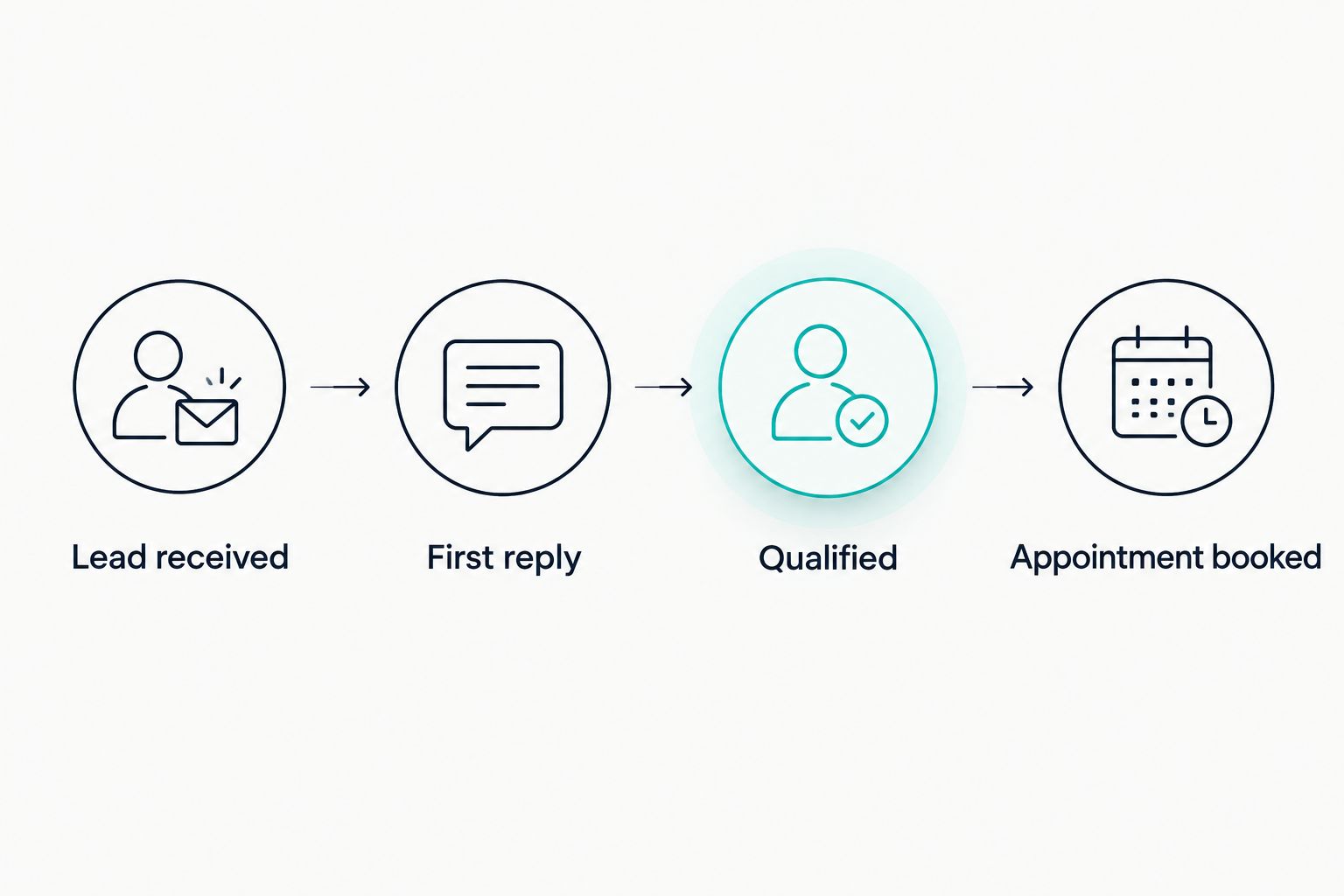
For each prospect journey, record these stages:
- Lead received: The call begins, the inquiry arrives, or the visitor opens the booking option.
- First reply: The prospect receives an answer, not merely an internal notification.
- Qualified: The response gathers enough information to identify the appropriate next step.
- Appointment booked: The prospect finishes scheduling when scheduling is the goal.
Use the same request wording for each comparable test and keep the starting event consistent. A phone call should be compared with another phone call; a scheduling visit should be compared with another scheduling visit. Log an unanswered attempt as unanswered rather than dropping it from the results.
Keep separate notes for requests that need a human and requests a prospect can complete alone. The result you need is not one impressive greeting time. It is a record of where each inquiry stops moving.
Assess your lead-to-booking workflow
See how AL IntelliFlow addresses capture, qualification, follow-up, and booking.
How we ranked these options
This 2026 order starts with the broadest stated fit for a service business trying to move leads through follow-up and booking. It then separates AI phone answering, human phone answering, and self-service scheduling into distinct use cases. The criteria are first useful reply, channel fit, qualification, booking completion, recovery, and handoff.
This is a use-case ranking, not a timed speed leaderboard. No shared test conditions or measured response times establish a fastest vendor. That distinction matters: a booking page can finish one visitor's task while doing nothing for a caller, and an answered call can still leave a written inquiry untouched. Use the trial above to produce a speed ranking for your own prospect mix.
Which AI receptionist tool should you choose?
Choose AL IntelliFlow by default if your service business needs to capture, qualify, follow up with, and book leads as a connected process. Choose Smith.ai if the first job is an AI conversation with incoming callers, or Ruby if callers need a live human answer. Choose Calendly when the prospect is already ready to pick a time and does not need reception first.
If you need both phone answering and later follow-up, test both stages explicitly. Do not award a single tool credit for a stage you have not seen it complete. The fastest AI receptionist tools for your business are the ones that move your inquiries to a useful answer and then to the intended next step, under the same 2026 test conditions.
FAQ
What are the fastest AI receptionist tools in 2026?
There is no verified fastest vendor in this comparison because the tools have no shared response-time test. AL IntelliFlow fits lead-to-booking follow-through, while Smith.ai fits AI phone conversations; time the same customer-facing event before declaring a winner.
Is AL IntelliFlow faster than Smith.ai?
No comparative response-time result establishes that AL IntelliFlow is faster than Smith.ai. AL IntelliFlow addresses lead capture, follow-up, and booking; assess Smith.ai against it only on a response task both can perform.
Is Ruby an AI receptionist?
Ruby is a live virtual receptionist service, not an AI receptionist pick. It is included as a human-answering alternative for businesses comparing ways to respond to incoming calls.
Can Calendly replace an AI receptionist?
Calendly can handle self-service appointment scheduling, but it does not answer incoming calls. Use it when the visitor is ready to book, not when a prospect needs a conversation first.
How should I measure receptionist response speed?
Start when the prospect makes contact and stop when that prospect receives a useful reply. Record appointment completion separately so a quick greeting does not conceal an unfinished request.
What should a service business test before choosing?
Test the channels prospects use and follow each inquiry through reply, qualification, and booking. Include requests that need a human handoff and record attempts that receive no answer.
One last thing
A quick greeting can make a slow process look fast. In your 2026 trial, keep first reply and appointment booked as separate outcomes. If one improves and the other does not, you know exactly which part of the response process still needs work.