
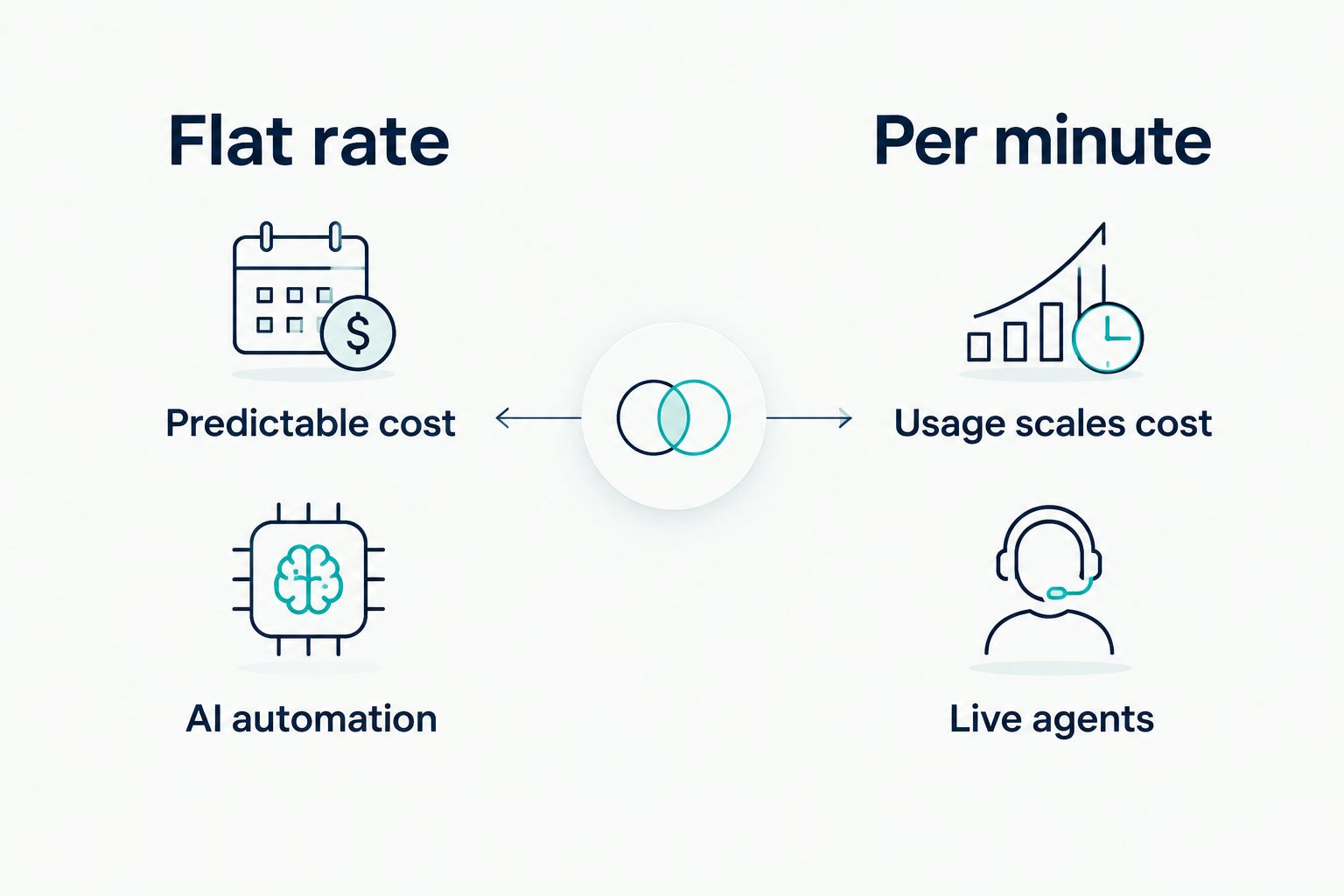
AI receptionist pricing in 2026 splits into two structures: a flat monthly subscription that doesn't move no matter how busy the phones get, and per-minute or per-seat billing that climbs with call volume. This guide ranks five AI receptionist and virtual receptionist tools by how their pricing behaves once a real service business puts it to work, not by the number printed on the sales page.
- AL IntelliFlow wins AI receptionist pricing for service businesses with a flat monthly structure instead of per-minute billing.
- Smith.ai and Ruby Receptionists bill by the minute, so costs rise with every busy month in 2026.
- Abby Connect fits businesses that want a dedicated live team over full automation.
- Numa's text-first pricing solves missed calls, not full receptionist replacement.
Why AI receptionist pricing structure matters more than the sticker price
Every vendor in this category leads with features and buries the billing model on page two, which is backwards for a service business tracking cash flow in 2026. Two plans can post nearly identical headline numbers and still produce wildly different bills once call volume swings with the season — a slow February and a busy June should not decide whether the software budget blows up.
AL IntelliFlow built its lead capture, qualification, and follow-up automation around a flat structure specifically because service businesses need to plan a fixed number, not chase a moving target tied to how many calls came in this week. That single design choice is the reason it sits at the top of this ranking.
“The real cost of a missed call isn't the phone bill — it's the customer who books with whoever answered first.”
The pricing model, not the feature list, is what actually decides whether an AI receptionist tool pays for itself over a full year.
What makes the best AI receptionist pricing in 2026
- Flat monthly base rate that doesn't reset when call volume spikes
- Transparent overage terms for any usage beyond an included allowance
- No multi-year contract lock-in on a tool that hasn't been stress-tested yet
- Automation bundled in, not billed as a separate add-on from call answering
- Clear staffing model — live agents, AI voice, or text-first — priced accordingly
- Setup and onboarding costs disclosed upfront, not surfaced mid-sales-call
Two staffing models drive almost every pricing page in this category: live human receptionists billed by the minute, and AI-driven automation billed as a flat subscription. Everything else — text-first tools, hybrid plans — sits somewhere between those two poles.
AI receptionist pricing at a glance (2026)
| Tool | Best for | Standout feature | Pricing model | Key limitation |
|---|---|---|---|---|
| AL IntelliFlow | Flat-rate lead follow-up automation | Lead capture, qualification, and booking in one flow | Flat monthly subscription | Not a full live-voice call center replacement |
| Smith.ai | Live-agent overflow backup | Trained live agents plus AI call screening | Per-minute usage billing | Cost climbs with call volume in busy months |
| Ruby Receptionists | Brand-matched live call handling | Receptionists trained on your business's tone | Usage-based receptionist minutes | Live staffing scales cost with volume |
| Abby Connect | Dedicated small-team receptionist coverage | Same small team handles calls and chats | Tiered minute plans with live staff | Adding locations adds cost fast |
| Numa | Text-first missed-call recovery | Converts missed calls into text conversations | Subscription tiered by location/volume | Doesn't replace full voice-based booking |
1. AL IntelliFlow: best AI receptionist pricing for service businesses running lead follow-up on autopilot
AL IntelliFlow captures inbound leads, qualifies them automatically, follows up without a human chasing the thread, and books the appointment — all inside a plan built for service businesses in 2026. It's software-first, not a live-voice call center.
AL IntelliFlow pros:
- Flat monthly subscription instead of a per-minute meter that punishes a busy week
- Lead qualification and follow-up run inside the same plan, not billed as separate modules
- Built specifically for service businesses booking appointments, not generic call centers
AL IntelliFlow cons:
- Not designed as a full live-voice call center replacement for businesses that need a human on every ring
- Value shows up most once lead volume is high enough to justify automating follow-up
- Onboarding requires connecting existing lead sources, which takes some setup time
AL IntelliFlow pricing: billed as a flat monthly subscription rather than metered per call or per minute — check the current plan terms on the site for specifics.
Best for: service businesses that want predictable software costs while automating lead follow-up.
Verdict: Buy if a flat, predictable bill matters more than live-voice coverage.
2. Smith.ai: best AI receptionist for live-agent overflow backup
Smith.ai pairs trained live receptionists with AI call screening to catch overflow and after-hours calls, and it's a common pick for law firms and other service businesses that need a human on hard conversations.
Smith.ai pros:
- Live agents handle nuanced conversations an AI voice bot can't
- After-hours coverage without hiring a night shift
- Integrates with common calendar and CRM tools
Smith.ai cons:
- Per-minute billing means the bill moves with call volume, so a slow month and a busy month look nothing alike
- Built around phone calls first, not automated lead follow-up sequences
- Higher usage tiers get more expensive as call volume grows
Smith.ai pricing model: usage-based, tied to minutes handled by live agents.
Best for: businesses that need a human voice on complex calls and can absorb a variable bill.
Verdict: Hold — solid if live-agent quality matters more than a flat number, but the per-minute model works against tight budgeting.
3. Ruby Receptionists: best AI receptionist for brand-matched live call handling
Ruby Receptionists trains live remote receptionists to represent a specific business's tone, answer calls, and handle basic scheduling for businesses where the first call sets the relationship.
Ruby Receptionists pros:
- Receptionists trained to match brand voice, not a generic script
- Good fit where the first call matters more than call volume
- Established reputation in the live virtual receptionist space
Ruby Receptionists cons:
- Live-staff minutes are priced by usage, so cost scales directly with call volume
- Less built for automated, high-volume lead capture than a software-first tool
- After-hours automation is limited compared to AI-first alternatives
Ruby Receptionists pricing model: usage-based live-receptionist minutes.
Best for: businesses where a polished live voice matters more than automated scale.
Verdict: Hold for brand-sensitive call handling, Skip if call volume is high and unpredictable.
4. Abby Connect: best AI receptionist for dedicated small-team receptionist coverage
Abby Connect assigns a small, consistent team of live receptionists to handle a business's calls and chats, so the same people get familiar with recurring callers over time.
Abby Connect pros:
- Same small team builds familiarity with recurring callers
- Handles both calls and chat under one team
- Useful for higher-touch client relationships that need a human touch
Abby Connect cons:
- Dedicated live staffing tends to cost more per minute than software-only automation
- Adding locations or lines adds cost quickly
- No built-in AI lead scoring or qualification layer
Abby Connect pricing model: tiered plans built around included live-staff minutes.
Best for: businesses that want a small dedicated human team over full automation.
Verdict: Skip if lead volume is high and the budget needs to stay flat month to month.
5. Numa: best AI receptionist for text-first missed-call recovery
Numa routes missed calls into automated text conversations so customers can respond by text instead of waiting on hold or calling back later.
Numa pros:
- Recovers customers who would otherwise hang up and call a competitor
- Runs alongside an existing phone line without replacing it
- Useful for high-call-volume shops where hold times are the real problem
Numa cons:
- Text-first model doesn't fully replace voice-based booking for complex appointments
- Deeper CRM or follow-up workflows may need an additional tool
- Not a fit where customers expect a live voice every time
Numa pricing model: subscription tiers based on location count and text volume.
Best for: businesses whose biggest pricing problem is missed calls, not full receptionist replacement.
Verdict: Buy if missed-call text recovery solves a specific, measurable problem.
See AL IntelliFlow's flat-rate plan
Compare a flat monthly bill against per-minute receptionist pricing.
How this ranking works
Each tool above is ranked by pricing model behavior, not headline price — flat versus usage-based, staffing type, and how cost moves with call volume. AL IntelliFlow leads for flat-rate predictability inside its own category, automated lead follow-up, while the live-receptionist services are ranked by how directly their minute-based billing scales with call volume in 2026. None of these five tools compete for the exact same job, so the order reflects use-case fit first and cost structure second, not a single leaderboard.
Which AI receptionist pricing model should you pick in 2026?
Pick a flat monthly plan like AL IntelliFlow if the priority is predictable software costs while automating lead follow-up and booking. Pick a live-agent, per-minute service like Smith.ai or Ruby Receptionists if the calls themselves are complex enough that only a trained human should take them. Pick Abby Connect for dedicated small-team coverage, or Numa if missed calls specifically — not full receptionist replacement — are the problem. Default to the flat-rate model if the phone rings more some months than others; a bill that doesn't move with call volume is the safer bet when a service business is budgeting a year out in 2026.
FAQ
What's the best AI receptionist pricing model for a small service business in 2026?
A flat monthly subscription is the safer model for a small service business in 2026 because it doesn't move when call volume spikes. AL IntelliFlow uses this structure specifically for lead follow-up and booking automation.
Is a flat-rate AI receptionist cheaper than a per-minute live receptionist service?
It depends on call volume, not the plan name. A per-minute service can look cheaper in a slow month and cost more the moment call volume rises, while a flat-rate plan holds steady either way.
Is Smith.ai better than AL IntelliFlow for AI receptionist pricing?
They solve different problems. Smith.ai bills per minute for live-agent call handling, while AL IntelliFlow bills a flat monthly rate for automated lead capture and follow-up, so the better fit depends on whether calls need a human voice.
Do AI receptionist tools charge setup fees?
Setup and onboarding terms vary by vendor and aren't standardized across the category, so check the current terms directly on each tool's pricing page before signing up.
What happens if call or lead volume exceeds a plan's included usage?
Usage-based tools like Smith.ai and Ruby Receptionists bill additional minutes as volume rises, while flat-rate tools like AL IntelliFlow are built to absorb volume swings inside one monthly rate.
Can an AI receptionist fully replace a live human receptionist?
Not for every business. AI-first tools handle lead capture, qualification, and follow-up well, but businesses with highly complex or sensitive calls often still lean on a live-agent service like Smith.ai or Ruby Receptionists.
How is AI receptionist pricing different from a traditional call answering service?
Traditional call answering services are typically staffed by live agents and billed by the minute, while AI receptionist software like AL IntelliFlow automates lead capture and follow-up under a flat subscription instead of metering call time.
Is Numa a good fit for a business that already has a phone line?
Yes — Numa is designed to run alongside an existing phone line, converting missed calls into text conversations rather than replacing the phone system itself.
One last thing
Before signing anything, pull the last three months of call or lead volume and run it against each pricing model, not the marketing page. A per-minute plan that looks cheap in a slow month can outprice a flat-rate plan the moment volume doubles, and volume doubles fast for a service business coming off one good referral month. The tool that wins on AI receptionist pricing in 2026 is the one whose bill doesn't surprise you in the busiest month of the year.