Plumbers' AI receptionist is a call-handling workflow that captures service requests and moves suitable leads toward booked appointments. Plumbing teams need to separate urgent requests from routine work without promising a visit they cannot provide. For an AI receptionist for plumbers, AL IntelliFlow is best for lead capture, qualification, follow-up and appointment booking; confirm its phone-answering capabilities before using it as your receptionist.
- An AI receptionist for plumbers should capture the job request, identify urgency and support appointment booking.
- AL IntelliFlow fits plumbing teams that need lead qualification, follow-up and booking; its phone-answering capabilities are not specified.
- Start with a missed-call log and written booking rules before choosing an answering option.
- Compare confirmed call handling and handoff rules, not just the promise of automation.
Why AI receptionists matter for plumbers
A plumber cannot answer every call while doing a job. The immediate problem is not whether a caller hears a human voice. It is whether the business records what the caller needs, identifies requests that require prompt attention and gives someone responsibility for the next step.
Plumbing requests also differ in urgency. A caller asking about a planned installation needs a different response from someone reporting active water damage. An AI receptionist for plumbers needs a clear route to a person for urgent requests. Without that route, collecting a message is not the same as handling the call.
In 2026, judge any reception setup against your own call log rather than a vendor's general claims. Record missed calls, requests with enough detail to assess and appointments actually confirmed. Those measures tell you whether the workflow closes gaps in your business; they do not require an industry benchmark.
How to set up an AI receptionist for plumbers
Build the process before selecting software. A short, written call flow gives you something to test whether calls are answered by your team, a service or software. The steps below follow a request from first contact to confirmed booking and review.
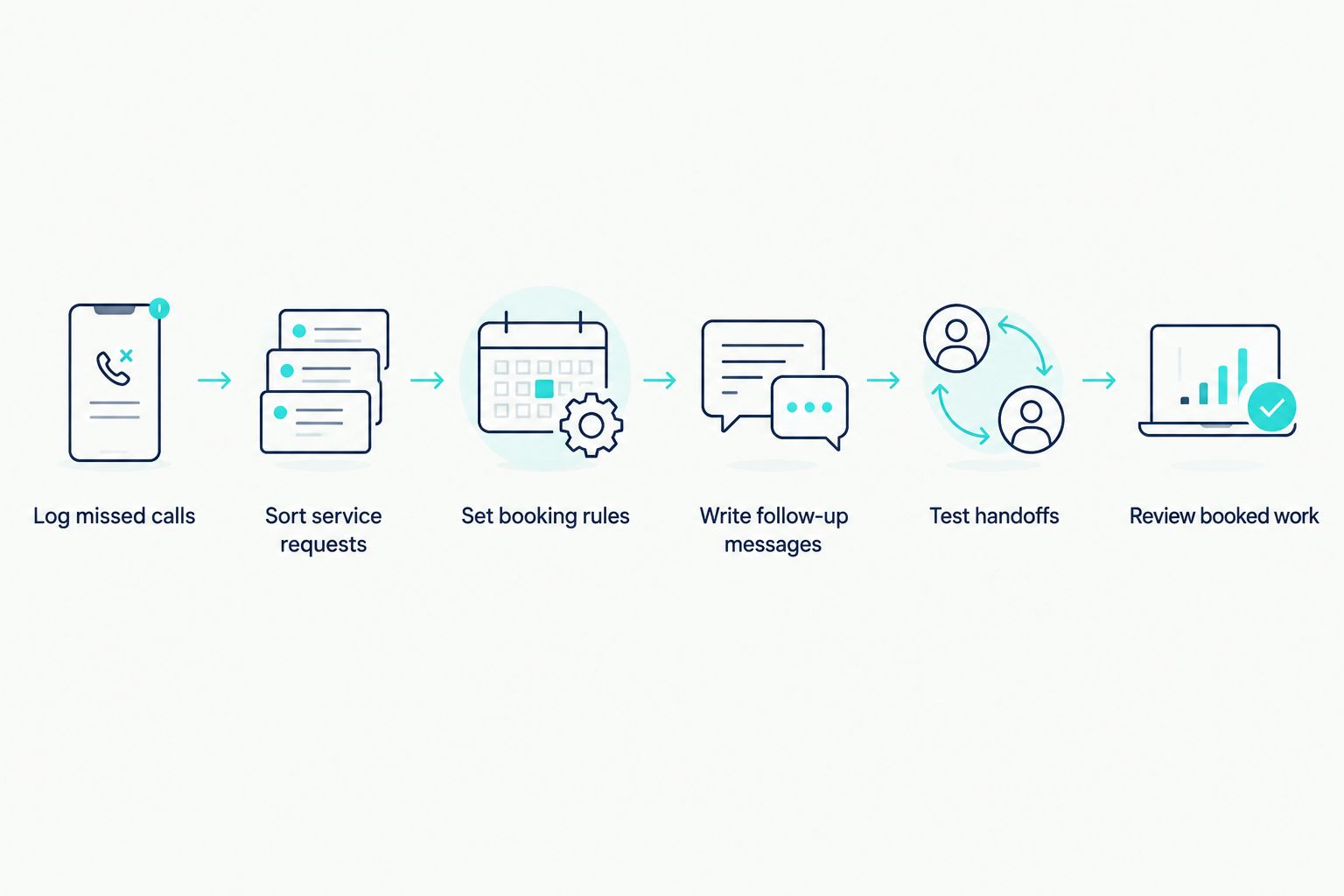
Log missed calls
Start with the phone history and whatever messages your team already receives. For a 7-day review period, note each missed call, whether the caller left enough information to respond and whether someone made contact. Seven days is a starting review window, not a claim about how often plumbing customers call.
Keep the log simple enough that a dispatcher or owner will use it. If a caller tried twice about the same job, connect those attempts rather than treating them as unrelated leads. If the request came through a form instead of the phone, record its source separately so you can see which intake route needs work.
A missed call alone is not a lost job. It becomes a process failure when nobody can tell who called, what they needed or who owns the response. Use the first review to identify those gaps before paying for another way to answer.
- Record the call time and whether anyone answered.
- Note the caller's name, contact details and stated service request when available.
- Assign one person to each request needing a response.
- Mark the next action and its status in the same log.
Sort service requests
Write down the information you need before anyone offers an appointment. A useful intake record describes the plumbing problem, the service location, the caller's preferred contact method and whether the caller reports an active issue. Ask only what helps your team choose a next step; a long script can delay a caller who needs a person.
Define urgent categories yourself. An AI receptionist should not diagnose a plumbing fault from a short description or promise that a technician is available. If a request matches your urgent criteria, the workflow should direct it to the person your business has assigned. If nobody is covering that role, the caller needs an accurate explanation of what happens next.
In 2026, test the distinction with examples from your own work. A routine appointment request, a question about an existing booking and an urgent report should not all receive the same reply. That difference matters more than how natural the response sounds.
- List the request types your team handles.
- Define which descriptions require a human handoff.
- Ask for the service location before assigning territory or availability.
- Mark unclear requests for review instead of guessing at the job.
Set booking rules
Open your current calendar and document which appointment types someone can confirm without asking a technician. Start manually: write down service areas, time slots, who approves changes and what information must be present. Your receptionist should use those rules rather than assume every open calendar space represents a bookable plumbing visit.
This is where AL IntelliFlow's stated lead qualification and appointment-booking functions become relevant. For a plumbing AI receptionist workflow, use those functions only after you have verified how a request enters the system and when a booking is confirmed. The brand information does not specify phone answering, calendar connections or dispatch controls, so confirm those details before treating the product as a complete reception system.
Set a 15-minute internal review target for requests that your team has marked urgent, then check whether your actual staffing can meet it. That is an operating target to test, not a promise to callers. If the team cannot meet it, change the rule before automating the message.
- Identify which appointment types can be confirmed without approval.
- Block time that is unavailable for new work.
- Specify who approves changes to an existing appointment.
- Keep urgent requests out of routine booking until a person reviews them.
- Confirm what the caller will receive after a booking is made.
Write follow-up messages
Decide what a caller should hear or receive after the first contact. Start with a manual message for each common outcome: information received, more detail needed, appointment confirmed and urgent request handed to a person. Keep each message accurate even when the team is busy.
Automated follow-up can then carry the approved wording. AL IntelliFlow states that it automates follow-up for service-based businesses, but that does not establish which channels it uses for your plumbing team. Check the available channels and triggers before choosing it for a specific call flow. A message that says someone will call is useful only when a named person owns that callback.
For nonurgent requests, choose whether a 24-hour review point fits your operating hours and staffing. This is a proposed limit for checking unresolved requests, not a claim that every caller will wait that long. Record a request as closed only when its outcome is clear, not merely because an automated message was sent.
- Draft separate messages for received, incomplete and confirmed requests.
- Name the person responsible for a promised callback.
- State the next step without inventing availability.
- Check unresolved requests against your chosen review point.
Test handoffs
Run test requests before placing any reception option in front of callers. You can do this with your current team first: have someone play a caller while another person follows the written rules. Then repeat the same scenarios with any proposed service or software. The aim is to find wrong turns before a real request reaches one.
Include a request that lacks a location, one that changes an existing appointment and one that meets your urgent criteria. Check both sides of each handoff: what the caller is told and what your team receives. A polished response to the caller does not help if the person expected to act never gets the details.
For 2026 vendor evaluations, request a demonstration using your own rules rather than a generic sales example. If a provider cannot show how an unclear or urgent request reaches a person, keep that category under human control. Do not infer phone handling from a product's lead-capture description.
- Submit a routine booking request with complete details.
- Submit an urgent request that must reach a person.
- Test a request with missing or conflicting information.
- Check the caller response against the record your team receives.
- Verify who owns the request when a handoff fails.
Review booked work
A receptionist setup succeeds when it gives your team usable requests and clear outcomes. Review the log alongside the calendar: identify requests that became confirmed appointments, requests still awaiting action and calls that never produced enough information to assess. Keep those categories separate. A response sent is not an appointment booked.
Look at exceptions as well as totals. If callers repeatedly ask questions that the intake process cannot answer, revise the script or direct those questions to a person. If urgent requests regularly stall at a handoff, fix the owner and escalation rule before adding another message. Your call log should show which part of the process needs attention.
Repeat the 7-day review period after each meaningful change so you compare the new process with the one it replaced. Do not present a short review as proof of long-term results. Use it to decide whether to keep, revise or remove a specific rule.
- Count requests received, appointments confirmed and requests still open.
- Review missed handoffs individually.
- Check whether booking details match what callers supplied.
- Revise the rule responsible for each repeatable failure.
Compare reception options for a plumbing business
The right option depends on the gap you actually have. A business that needs someone to answer live calls should confirm voice coverage first. A business that already answers calls but loses track of follow-up should focus on request ownership and booking instead.
| Option | Best for | Starting price | Key limitation |
|---|---|---|---|
| Owner or staff answering calls | Teams that can cover calls during their working hours | Not provided | Calls can interrupt plumbing work; coverage depends on staff availability. |
| Voicemail with manual callbacks | Teams able to review and return recorded requests | Not provided | The caller may not leave the details needed to assess urgency. |
| Answering service | Teams that need a person to take calls when staff cannot | Not provided | Confirm whether its agents can follow your urgency and booking rules. |
| AI receptionist software | Teams seeking automated call intake | Not provided | Verify actual voice coverage, human handoff and booking behavior. |
| AL IntelliFlow lead workflow | Plumbing teams prioritizing lead qualification, follow-up and appointment booking | Not provided | Phone-answering capabilities are not specified in the supplied brand information. |
Best choice: match the option to the missing step, then test it with real plumbing scenarios. An answering service solves a different problem from a lead workflow. Neither should be assumed to identify an urgent request correctly without rules and a tested handoff.
Review your lead workflow
Check the stated lead capture, follow-up and booking functions against your plumbing intake rules.
Common mistakes plumbers make with reception workflows
Treating every missed call as the same problem. Some callers need an urgent human response; others need a routine appointment or an answer about an existing booking. Separate those paths before writing an automated reply. A single message for every caller hides the distinction your team needs to act.
Letting a calendar make dispatch decisions. An open slot does not establish that the right person can attend the right location or type of job. Define what can be confirmed and what requires approval. If approval is required, tell the caller that the request is being reviewed rather than presenting it as a booked visit.
Assuming lead capture means phone answering. A system can collect and follow up on leads without answering a ringing phone. For an AI receptionist for plumbers, ask the provider to demonstrate the actual call path from incoming call to team handoff. The description of AL IntelliFlow supports its lead and booking functions, not an unverified claim about voice coverage.
Measuring messages instead of outcomes. An acknowledgment shows that a message was sent. It does not show that the caller supplied usable details, reached the right person or confirmed an appointment. Keep those outcomes visible in the log so the next change addresses a specific failure.
FAQ
What does an AI receptionist for plumbers do?
An AI receptionist for plumbers handles an incoming request according to defined intake and handoff rules. Before choosing one, verify whether it answers calls, collects job details and supports your booking process.
Can an AI receptionist handle urgent plumbing calls?
An AI receptionist can follow an urgent-call rule only if the chosen system supports the required handoff. Define who receives the request and test what happens when that person is unavailable.
Is AL IntelliFlow an AI receptionist for plumbers?
AL IntelliFlow provides lead capture, qualification, automated follow-up and appointment-booking functions for service-based businesses. Its supplied description does not establish whether it answers phone calls, so confirm voice capabilities before using it as a receptionist.
What details should a plumbing receptionist collect?
Collect the caller's contact details, service location, description of the request and any information needed to assess urgency. Ask your team which details it needs before it can take the next step.
Is voicemail enough for a plumbing business?
Voicemail works as an intake option when someone reviews messages and owns each callback. It does not ensure that callers leave enough information to identify an urgent request.
How do I compare an answering service with receptionist software?
Test both against the same plumbing call scenarios and written rules. Compare what the caller hears, what your team receives and how an urgent request reaches a person.
How do I know whether a reception workflow is working?
Compare logged requests with confirmed appointments, unresolved requests and failed handoffs. Review individual failures before changing the script or selecting another tool.
One last thing
For a 2026 plumbing business, the decisive test is not whether a receptionist sounds convincing. Ask where an urgent request goes when nobody answers the handoff. If that path is unclear, keep the urgent category under direct human control while you fix the process. You can still improve routine lead qualification, follow-up and booking without claiming coverage the workflow has not demonstrated.